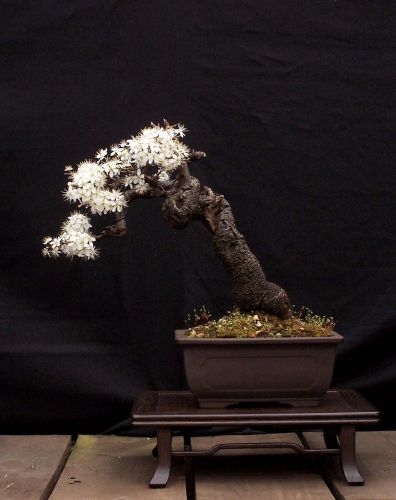
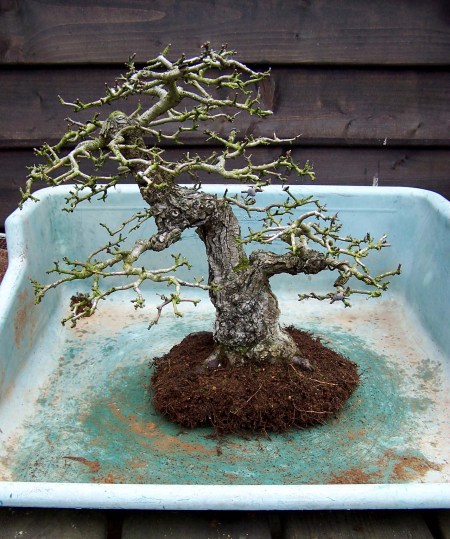
A PICTURE OF MY SMALL BLACKTHORN IN FULL BLOOM.

Hi, everybody,

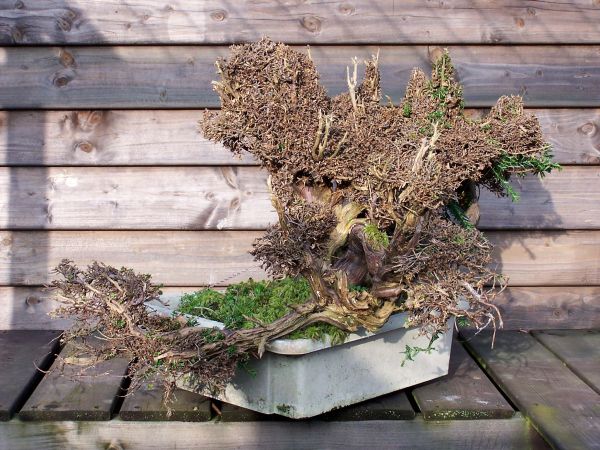
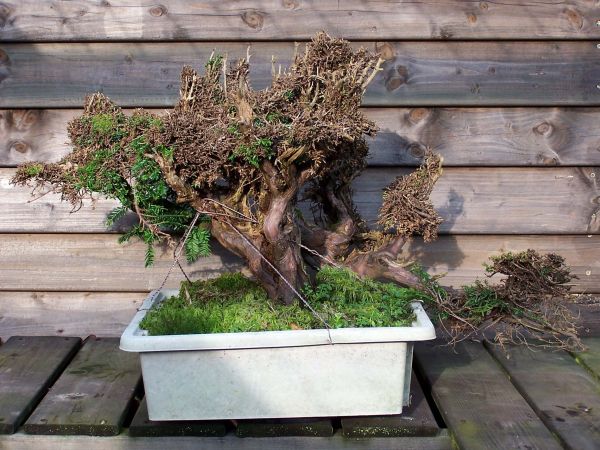
here is a picture of a small Blackthorn from my collection. It is a Yamadori from the U.K that was given to me, a few years ago, by my dear friend Terry Foster. The upper half of this trunk is fully twisted around with a Shari running along it. And there is some Jin hidden amongst all those sweat smelling flowers! Next year I will find a more suitable pot for it!

Blackthorn "Prunis spinosa".
Blackthorn “Prunus spinosa”.

Hope you like it?

Cheers,

Hans van Meer.

Info: karamottobonsai@hotmail.com

——————————————————————————————–

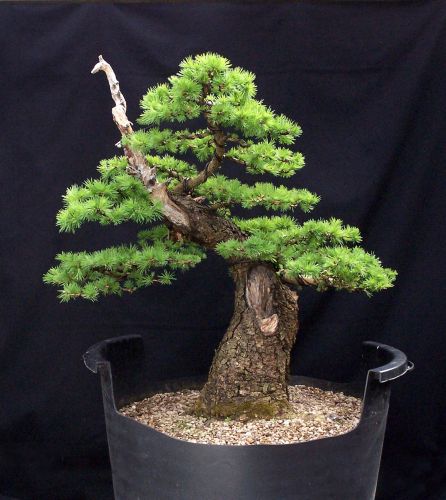
A PICTURE OF “XL”.

Hi, everybody,

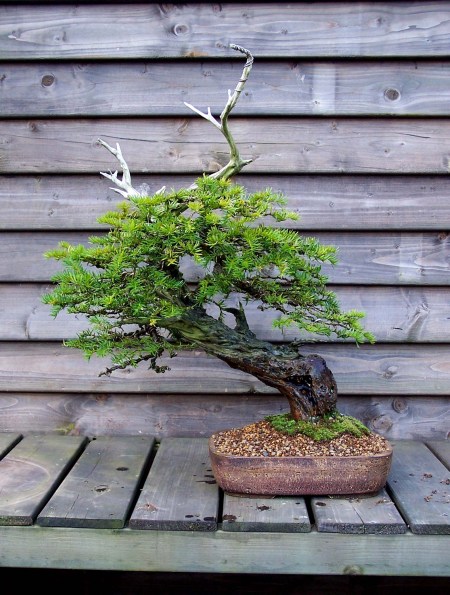
today was a lovely Sunny day, so I decided to make a  picture of the “XL”, so I could show you how it looks at this moment with its bright green coloured new foliage. It needs a lot more branch ramification, but the basic shape is there already.

I hope you like the progress of this tree?

Cheers,

Hans van Meer.

13-4-2009-xl-026-web

                                   Info: karamottobonsai@hotmail.com

——————————————————————————————–

MY WORKSHOP AT “ISS HOGAI” IN SUNNY EMMEN (HOLLAND)!


Hi, everybody,

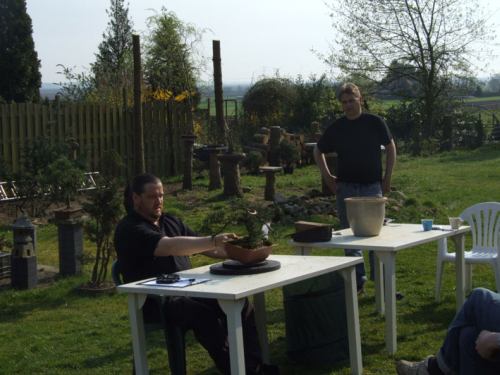
I met Henk Steneker, the organizer of this workshop, during the Masterclass I did last year. There he asked if I would like to give a workshop in the following year at his relative new Bonsai shop “Iss Hogai” that is based in his new house in Emmen (Holland). Well, of course, I said yes and last weekend it was time for me to make the 2 and a half hour long trip to the North East of Holland. I made it in one go and arrived right in time for a warm welcome by Henk and a cup of coffee with cake! He showed me around his large garden that is being converted to a Bonsai garden with benches for his and his club members Bonsai and a large area to work. There is a nice indoor section in his garden to work when it is cold and raining or as in this case, rather hot! His club consists of a small but very enthusiastic group of Bonsai junkies, that had a great time during this sunny day! It is good to know, that there are so many people in Holland that are willing to make that extra effort to progress in their hobby! Because I know that improvement through working on Bonsai, will make this magnificent hobby, even more, enjoyable for them!

Below: First we started with discussing the trees that the students had brought along.
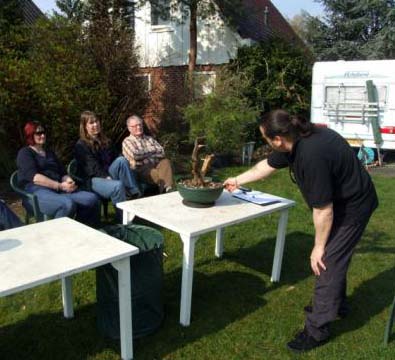
Below: One by one the unworked material, pre Bonsai or Bonsai were discussed by me.
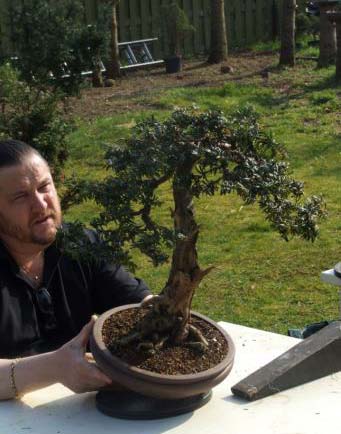
Below: Rene pulling my leg when he brought with a straight face a half-dead Ulmus to see how I would react and talked my way out of it without hurting any one’s feelings! 🙂
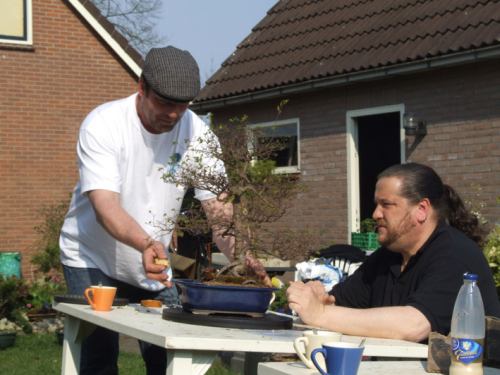
               Below: Rene’s very promising Yamadori, Mugo Pine.
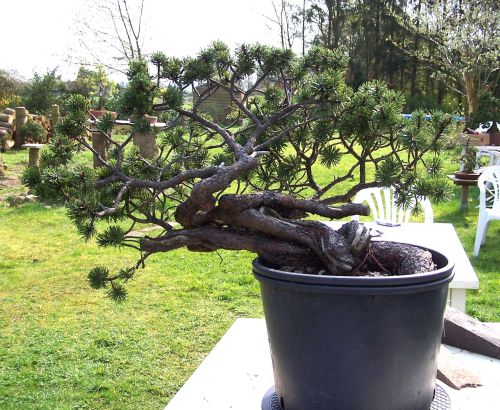
A very promizing Mugo pine!

                  Below picture: discussing the trees possibilities.
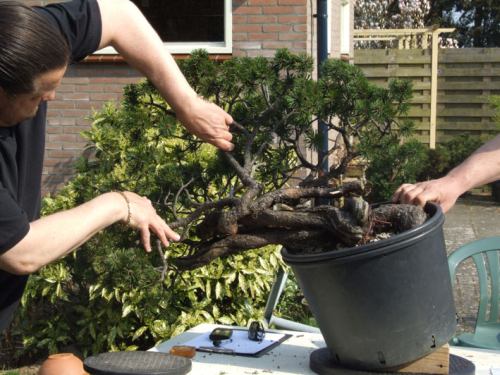
                                                     Below picture: WHAT ?!
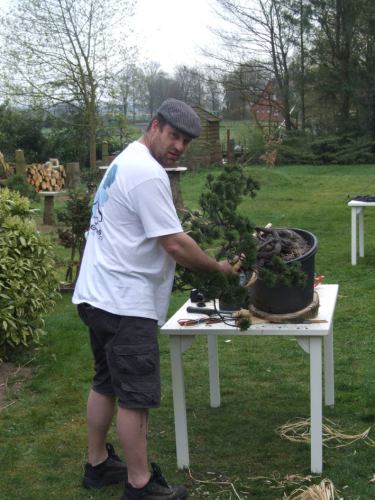
 

                 Above: Harry Gerdes concentrated at work on his Juniper.
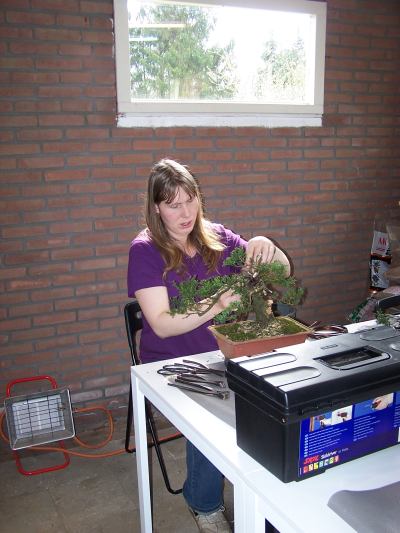
              Monique van Ommen, working indoor were it was much cooler!
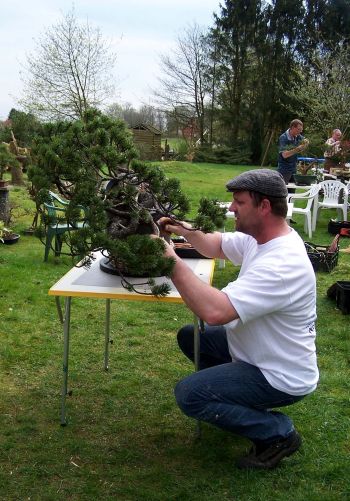
Rene Bakker was very eager to start working on his Pine. I cant blame him! 🙂
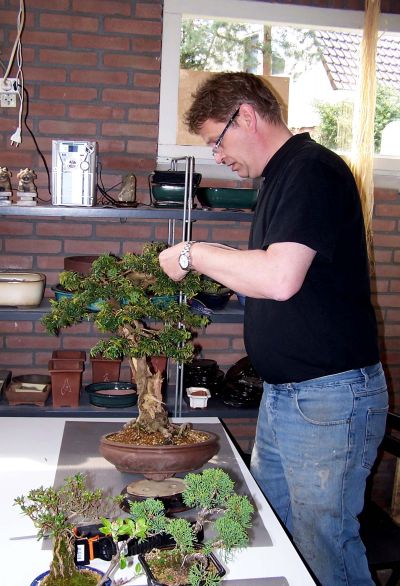
Above: Henk Steneker, founder of this club and organizer, hard at work on his “Taxus”.


Above: Anneke van Lintum, enjoying Bonsai! A picture that speaks for itself!
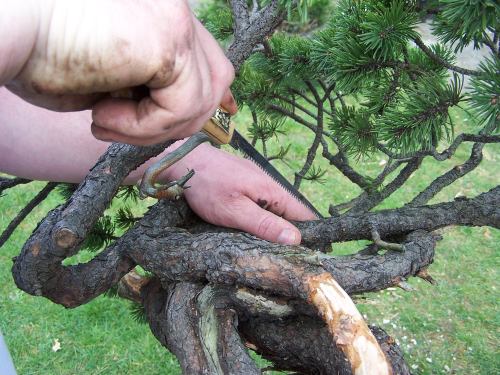
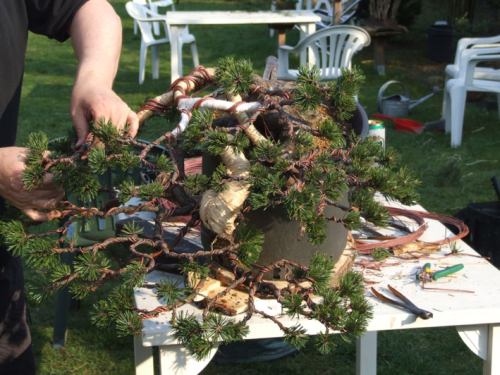
Above: Rene, bless his heart, did not hesitate to cut off and bend some major branches, after we discussed where we could go with his magnificent old “Mugo”!
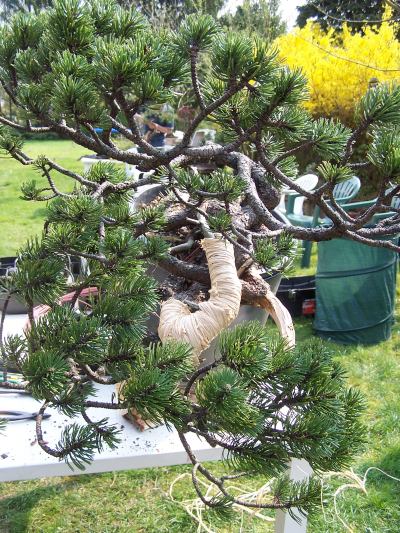
Above: Wet raffia was applied to prevent branches to break when they were severely bent.
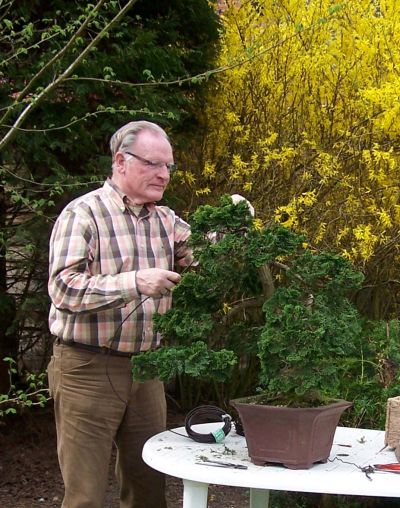
                          Above picture: Bram de Visser working on his tree.
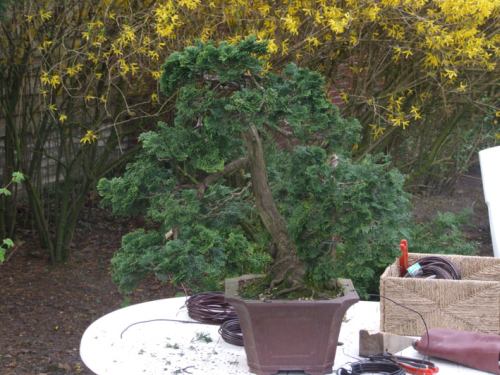
     Above picture: Bram’s “Chamaecyparis” obtusa before his work started.
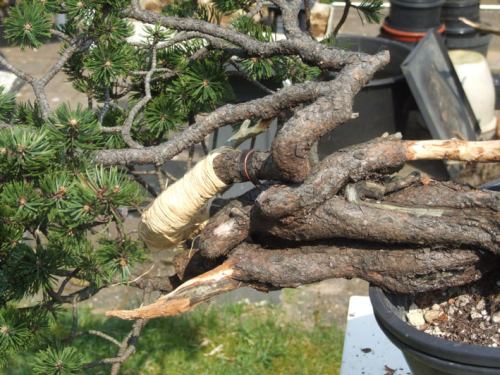
                                      Above: The cut off branch is Jinned.
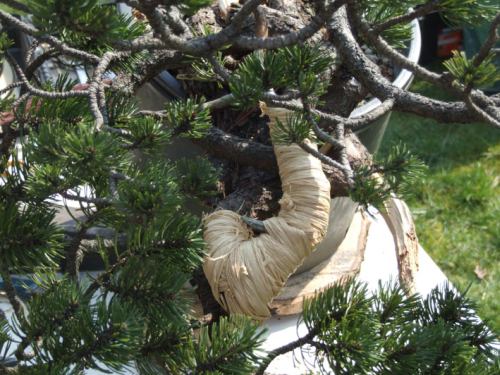
Above: The well-protected branch is slowly brought into its desired position.
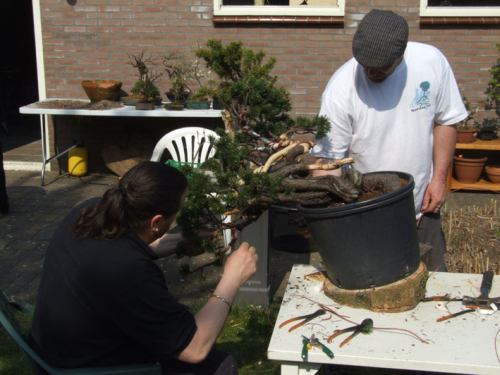
 Above: Even after all of the students were gone we went on wiring and styling…we both wanted to see this great tree finished! 😉
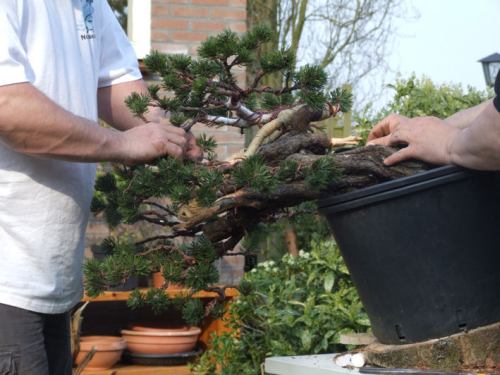
    Above: Almost everything wired and brought into its desired position.!
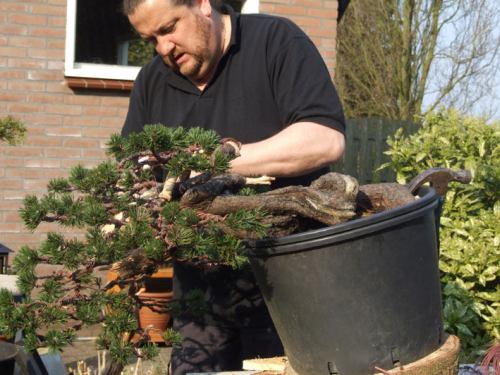
After a long day of bonsai work, it was nice to finish off with a promising tree like this one! And than it was time for a nice cold beer with my new Bonsai friends from up North!

Above: Bending the last branches of the top into place! After a long day of bonsai work, it was nice to finish off with a promising tree like this one! And then it was time for a nice cold beer with my new Bonsai friends from up North! And then it was off for the long trip home…tired but very happy and satisfied!

Hope you enjoy the images as much as I enjoyed this day!

Cheers,

Hans van Meer.

Info: karamottobonsai@hotmail.com

——————————————————————————————–


GROMING THE “SWAN” MY OLD MUGO PINE YAMADORI.

Hi, everybody,

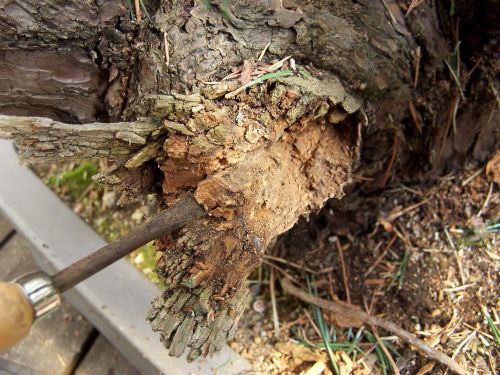
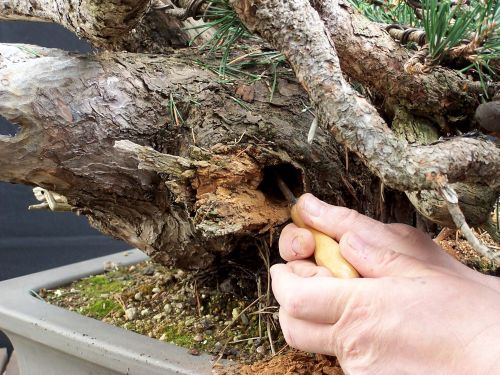
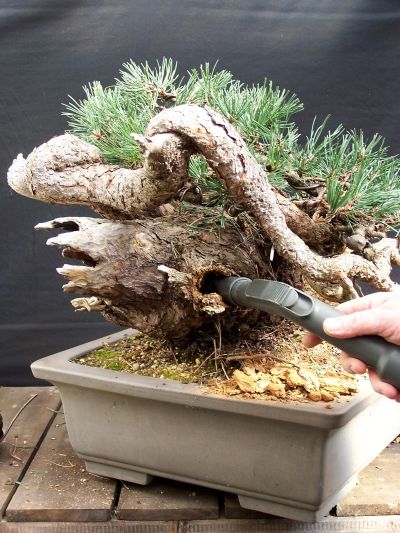
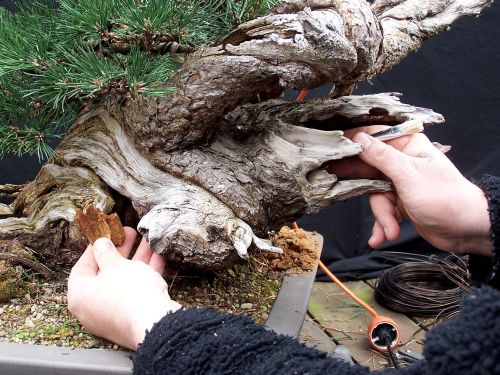
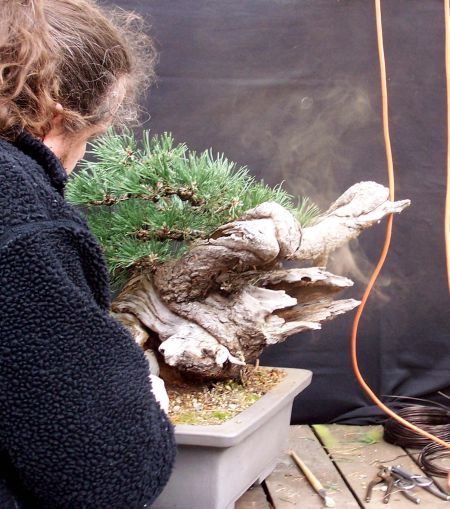
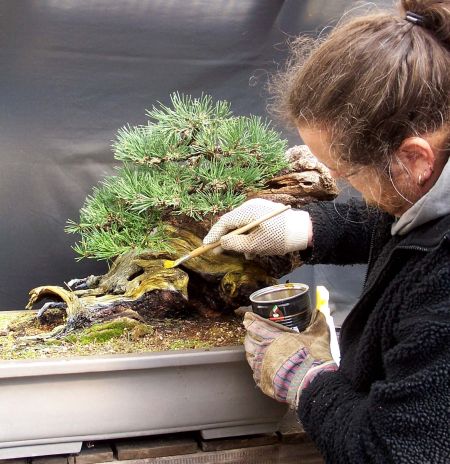
here are some pictures of the deadwood work I did this afternoon. This work was mostly aimed at removing as much rotted wood from the inside of the tree. And then treating the deadwood with lime sulphur. Enjoy the pictures!

29-3-2009-085-web-hans-van-meer

29-3-2009-091-web-hans-van-meer

29-3-2009-103-web-hans-van-meer

                                 Like sucking the eye out off a moose! Hi-hi!

29-3-2009-113-web-hans-van-meer

          Poking from the right entrance and removing from the middle one!

29-3-2009-137-web-hans-van-meer

A very intimate view of the cave-like inside of the “SWAN”.  Preventing this fragile section from further decay will be my main worry in the future. As long as I can control that, the tree will outlive me by fare! 🙂

29-3-2009-156-web-hans-van-meer

When I was cleaning the inside from the hole in the middle front, the wood dust disappeared from the right side exhaust pipe, like a genie from his lamp!

29-3-2009-172-web-hans-van-meer

Although it is with pain in my heart, I do have to protect this deadwood every now and then In the future, to keep things under control. And after I had tasted, the lime sulphur I am applying here, multiple times on the deadwood of this pine, I discovered that this terrible pearly white deadwood will lose it’s unnatural glow very quickly. And I also have some Trix up my sleeve to hurry that proses a little bit more.

29-3-2009-240-web-hans-van-meer

                            Happy… happy happy! Happy….. happy happy! 🙂

Hans van Meer.

Info: karamottobonsai@hotmail.com

————————————————————————————–
—————————————————————————————————


IT TOOK ME A WILE, BUT HERE IS THE NEW “SWAN”.

Hi, everybody,

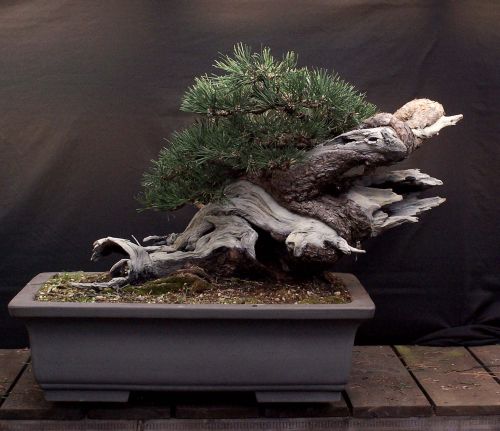
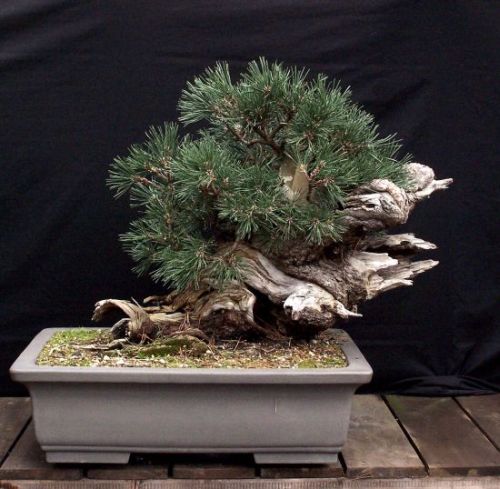
it might have taken me the better part of 2 days, but today I finished the styling of the foliage on “THE SWAN”.  The tree was placed just too high for me, to comfortably wire it and I am not able to lift a big tree like this anymore, with the state my back is in at this moment. I might only just start working on Shohin in the future. NOT! 🙂 I had to make some big decisions and a lot of branches had to be removed and replaced by the branches I had allowed to grow especially for this purpose. Just how this all was done, you can read on my website in a few days! Together with the story of the first styling of “THE SWAN”!

24-3-2009-001-web2

28-3-2008-063-web1

Well, here she is, the new “SWAN”! I am really pleased with the result so far, it is going a lot faster than I had hoped for. The whole tree has so much character and a nice flow to it, the vibrant green foliage leaning on and embracing the massive hollow trunk, with all it’s deadwood, clinging on to live on this weather battered fallen over high mountain pine. It is almost a living JING/JANG symbol I am really Hope you like it so far?

More deadwood work will follow tomorrow!

Cheers,

Hans van Meer.

Info: karamottobonsai@hotmail.com

————————————————————————————–
SOME STYLING WORK ON “X.L” MY BIG YAMADORI LARCH.

Hi, everybody,

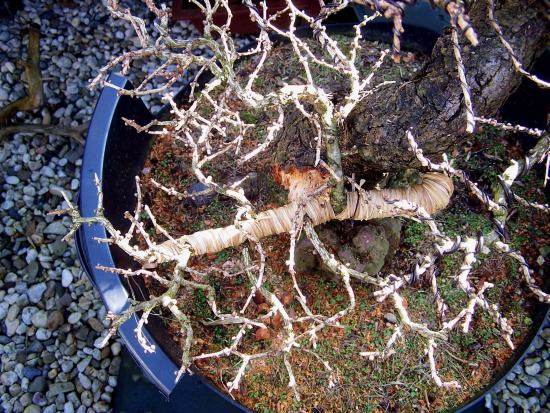
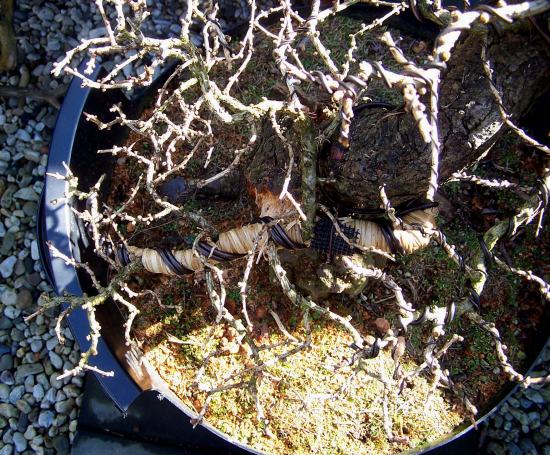
Above pictures: The secondary branch structure is getting better on all the branches, but the straight line of the first branch on the right is bothering me. This is the only older branch on this tree and it needs a bit off help to get some gentle movement. This way it looks less boring and will fit the rest of the branch structure of this tree. Straight lines must be avoided at all times in a successful design, the stick out like a sore thumb! So I wrapped it in water soaked raffia and bent some movement in it.

I know! I'm a tree hugger!

                                       Above: I know! I’m a tree hugger!

Above pictures: It was hard to place my hands on this branch to bend it, but you can see I managed to great a gentle curve in that straight and thick branch in the end! Now it fits the rest of my branch structure. In Bonsai you have to pay attention to every little detail, even if you think no one will knottiest what you are doing. A lot of small mistakes will make a big one!

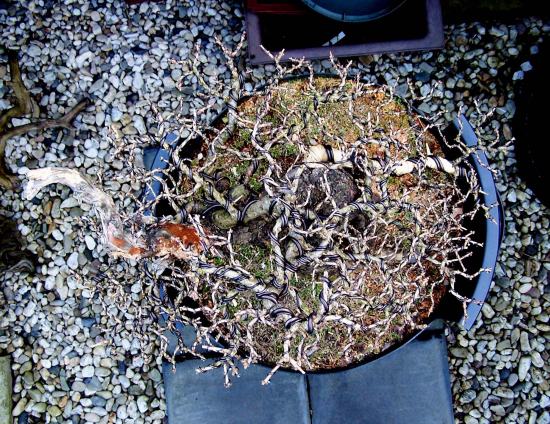
                             Above: Bird’s eye view of the branch structure.

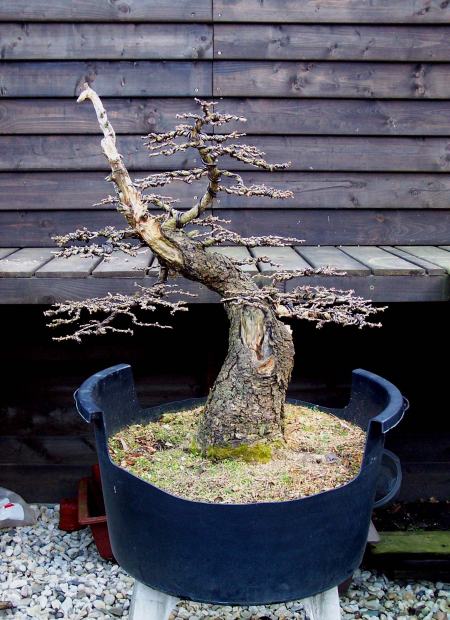
Above; I made this picture with a backdrop to make the branches stand more out. I am really happy how the image of “X.L” is progressing. I can’t wait to see how he will look in a few weeks, when the brightly, and still very small, green needles start appearing. Then the scale of this old Larch is at it best! Maybe next year, if possible, I will plant him in a nice pot? I hope you like the progress so far?

Cheers,

Hans van Meer.

SOME PICTURES OFF THE WORK I DID LAST MONTH!

Hi, everybody,

it’s has been a while

Some serious bending going on.
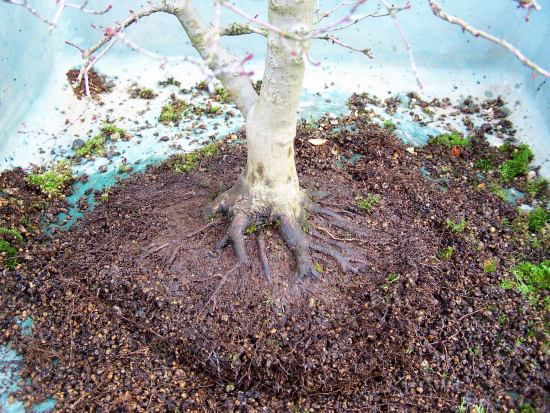
These roots, on one of my Acer palmatum’s, are begining to look nice.

Here the tree is back in it’s old pot, as soon as it is settled down and showing lots off new growth, I will start to wire it again and bring it back into its desired form. I am glad this tree recovered from it’s ordeal so well, it holds a lot of good memories for me!
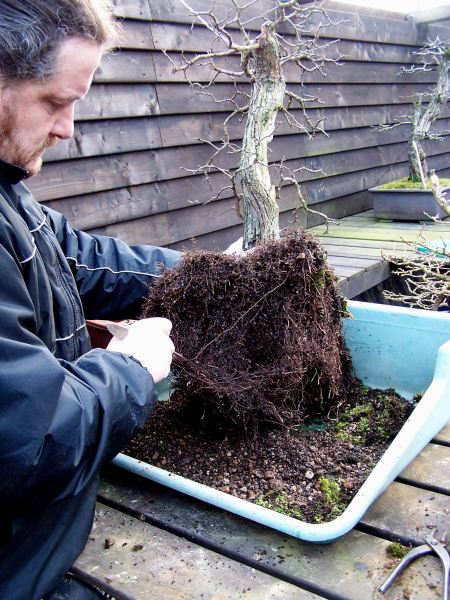
Look how flat the football, consisting of only small feeder roots, is now! This means I can plant it deeper into it’s pot and that the tree will look more balanced in it!
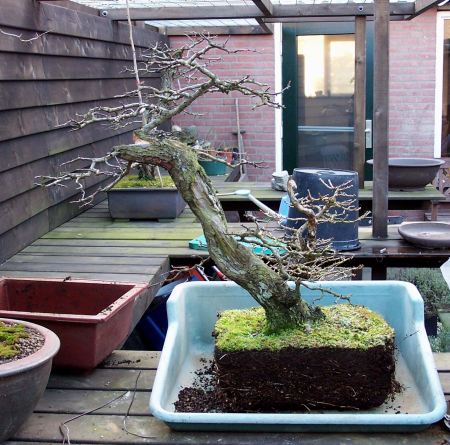
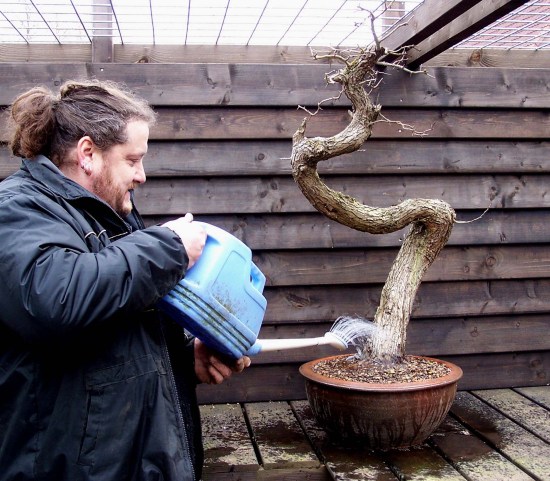
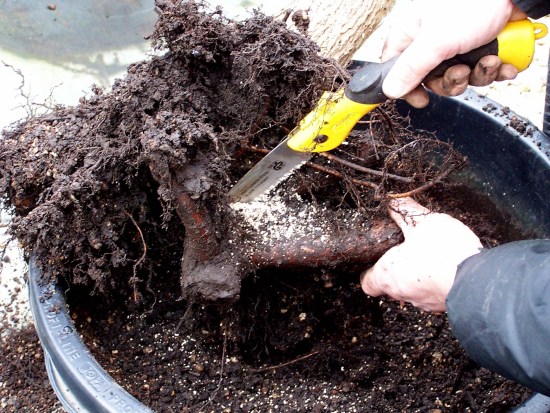
Here I am removing more off the old rootstub that was left for safety the last time this old Yamadori “Yew’ was repotted. This “Yew” I found in the U.K, many years ago now and it is the first tree that I ever collected. This tree lost a lot off its vitality 2 years ago and some lower branches on the left were lost, but now it slowly recovered and it was safe to work on the roots again!
For now this “Dancer” has a new home, were it can grow into a beautiful lady! 🙂
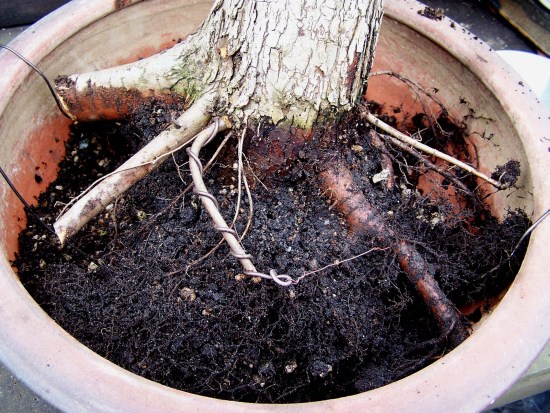
Some promising roots were redirected with wire. Thicker roots were cut back, right up, to about half a Inch away, from were strong, but smaller roots emerge from it. This simple, but sure technique, will be repoted, until the overall roots size, fits inside the planed design for this tree.
For now she is planted in a deep pot, with plenty of room to grow. I want a vigures tree, that produces lots of new growt to fill out and style the top section of this future Literati Bonsai.
Now I am left with a nice flat rootbase, full of fine feeder roots. This means that at the next repoting, I will be able to plant this tree in a much shalower pot. This wil make here, more elegant and smaller…she is a bit tall! 🙂
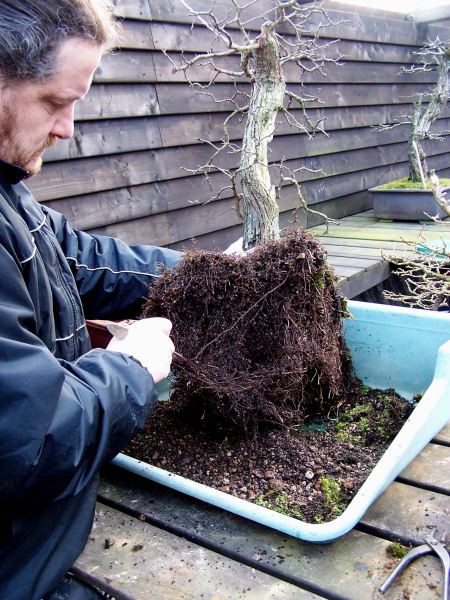
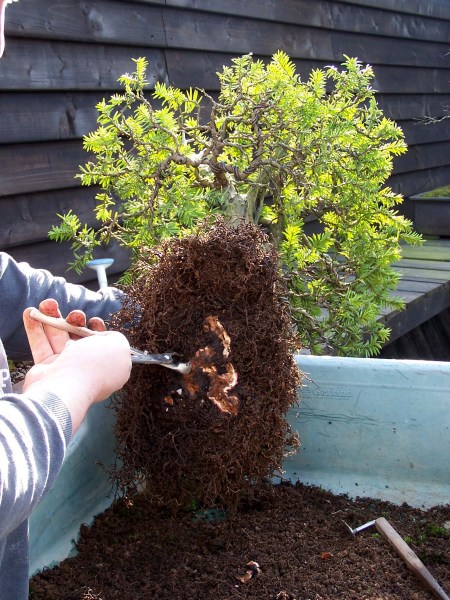
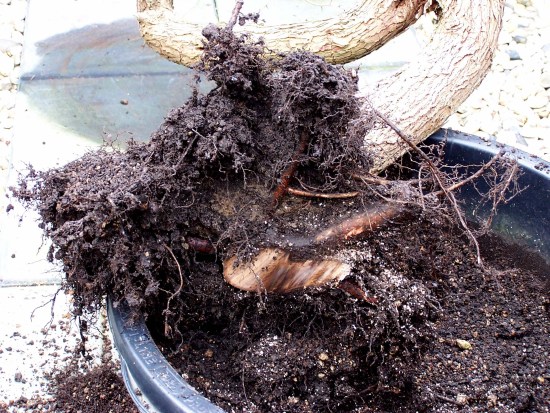
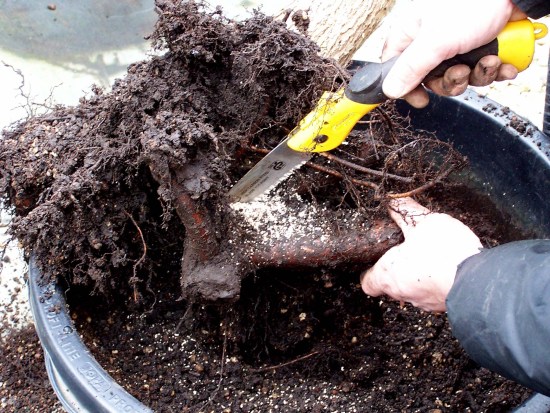
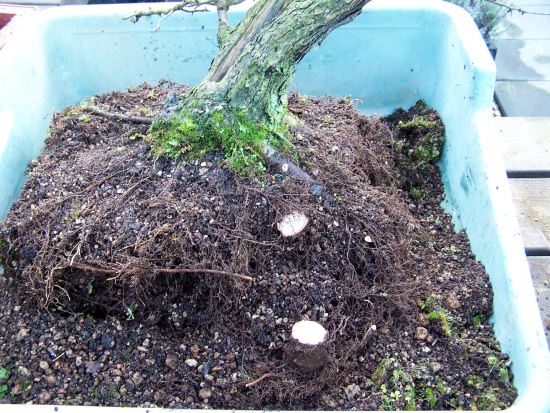
Here I am removing the extra roots I left on for extra security when I collected this Dutch Yamadori “Hawthorn”.
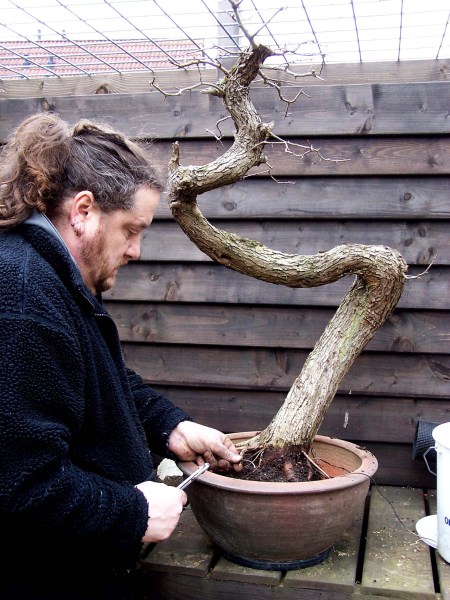
Repotting the “DANCER”.
Moments of joy! 🙂
Here the tree is planted back into it’s small Brian Albright pot.
Side view of the “larch” stumb. 🙂

Here the same tree is planted back into it’s Brian Albright pot.
Not me!:) Here is a other Hawthorn with only small feeder roots.
Who sad that you could not get, a easy to repot, root system on a Hawthorn?

, I know! But I had to take a few steps back from the keyboard and try to focus on the more important things in life, mainly my health! These last few month’s, my back problems have become more severe and kept me more or less away from any real Bonsai work. But I did do some important small styling work and some repotting that could not wait any longer! At this moment I am gladly posting these pictures in the knowledge that there might be a solution for my back problems in the near future. I have found a great Doctor in Belgium that uses a new kind of operating technique! So now I only need the O.K from my insurance company and I am off to Belgium! So keep your fingers crossed for the next couple of days for me! 🙂
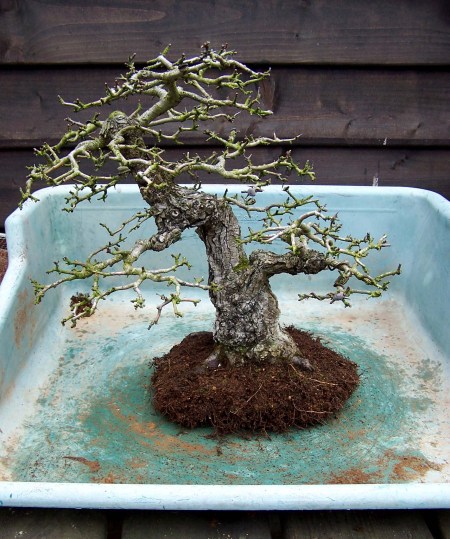
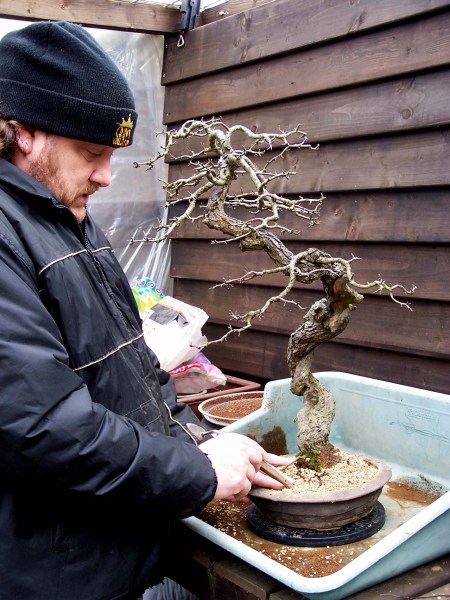
 Who sad that you could not get, a easy to repot, root system on a Hawthorn?

Who said that you could not get, an easy to repot, root system on a Hawthorn?

Not me!:) Here is a other Hawthorn with only small feeder roots.

 Not me!:)  Here is another Hawthorn with only small feeder roots.
Here the tree is planted back into it's small Brian Albright pot.
Here the tree is planted back into it’s small Brian Albright pot.

larix-zondag-23-februari-2009-012-web

Side view of the "larch" stumb. :)       Moments of joy! :)

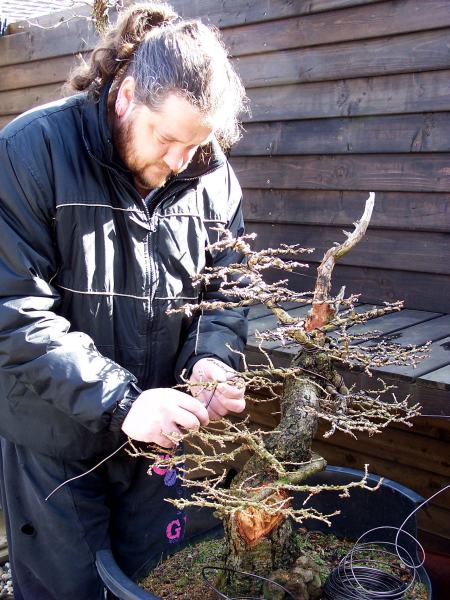
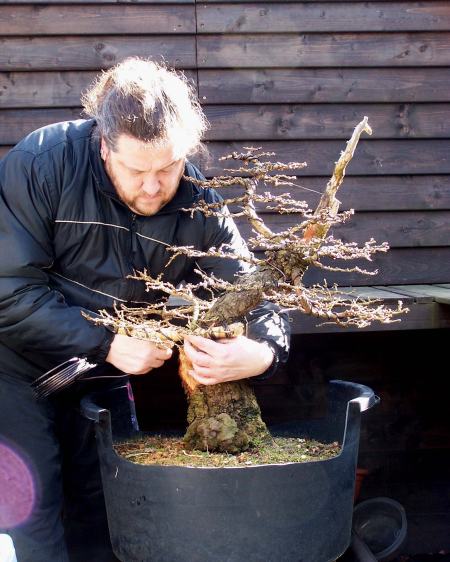
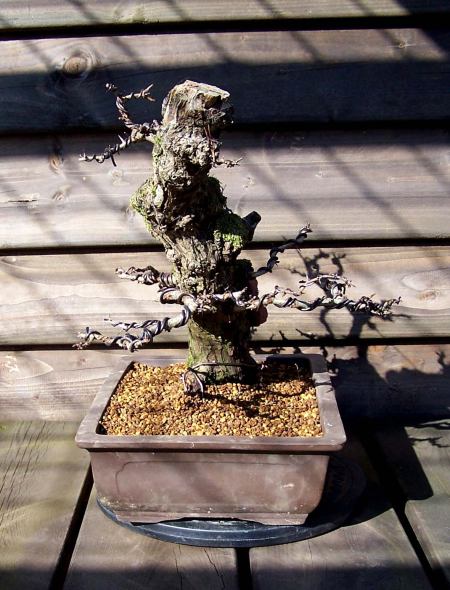
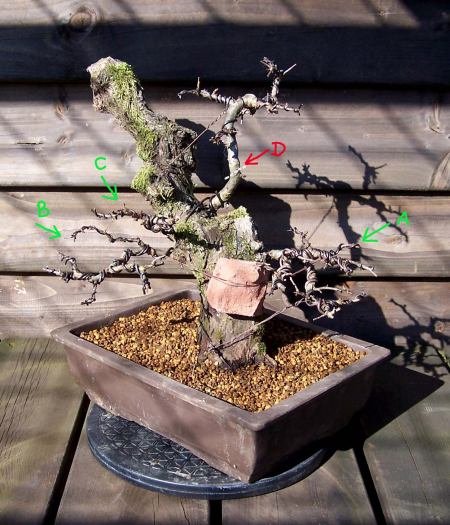
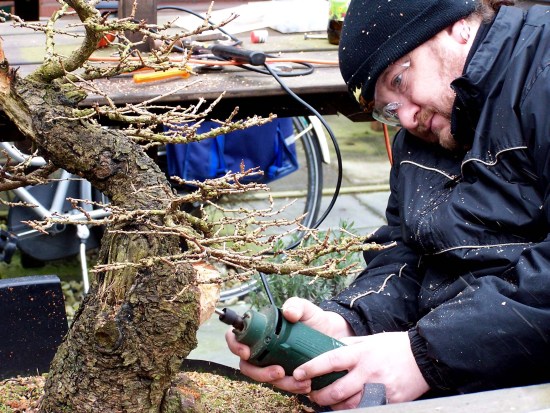
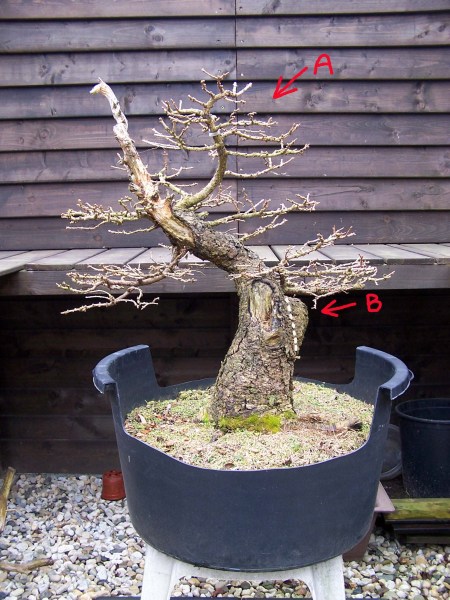
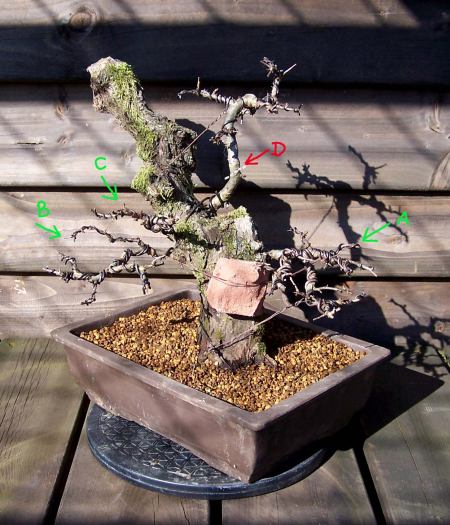
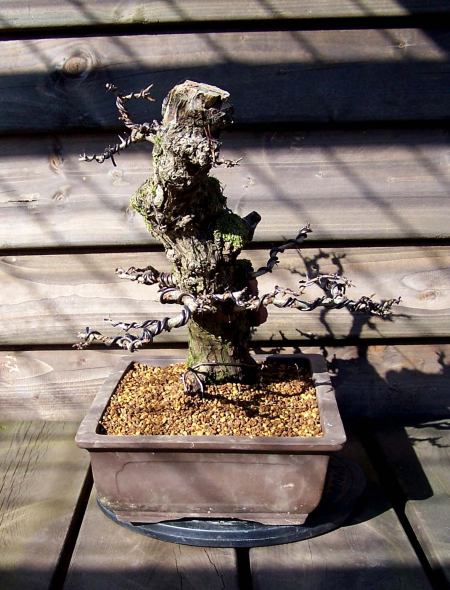
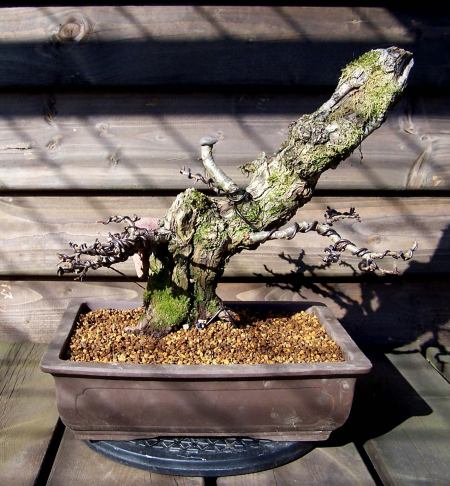
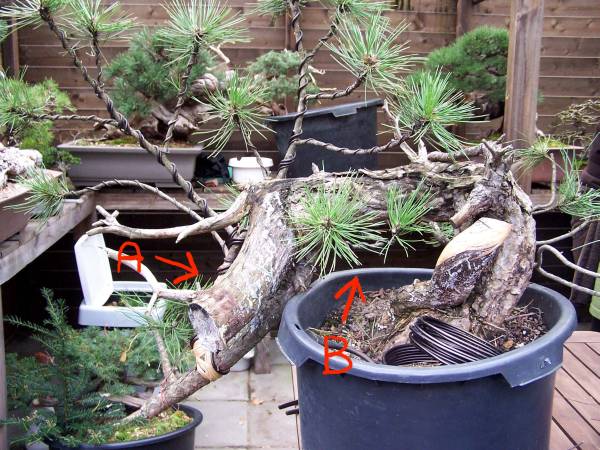
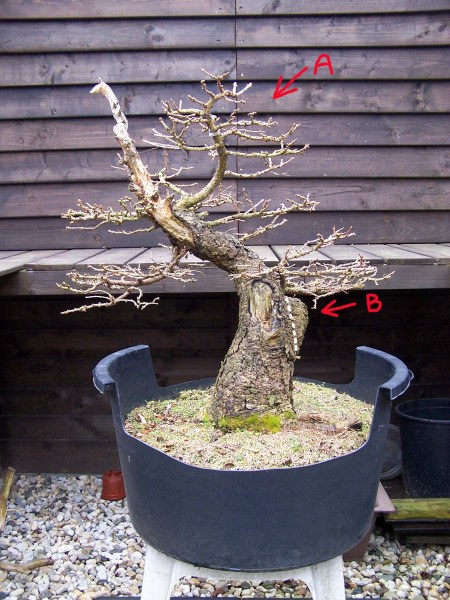
 Above: This “Larch” has been completely wireless during the winter months. So, considering the short time I have been working on this tree, I am pretty pleased with how quickly the, mostly new branches,  have already settled in their position. Only the (Youngest) top section (A) needs to be repositioned. I had left the Large stump (B) alone for a few seasons, to prevent the risk of dye/dry back in the main trunk. So now it was safe to remove most of it with power and hand tools and then style it in harmony with the spirit of this tree! The white dotted line is more or less the line of the trunk, so a lot of work had to be done to get there!

Repotting the "DANCER".
Repotting the “DANCER”.
Here I am removing the extra roots I left on for extra security when I collected this Dutch Yamadori "Hawthorn".
Here I am removing the extra roots I left on for extra security when I collected this Dutch Yamadori  “Hawthorn”.
Now I am left with a nice flat rootbase, full of fine feeder roots. This means that at the next repoting, I will be able to plant this tree in a much shalower pot. This wil make here, more elegant and smaller...she is a bit tall! :)
Now I am left with a nice flat root base, full of fine feeder roots. This means that at the next repotting, I will be able to plant this tree in a much shallower pot. This will make her, more elegant and smaller…she is a bit tall! 🙂
For now she is planted in a deep pot, with plenty of room to grow. I want a vigures tree, that produces lots of new growt to fill out and style the top section of this future Literati Bonsai.
For now, she is planted in a deep pot, with plenty of room to grow. I want a vigorous tree, that produces lots of new growth to fill out and style the top section of this future Literati Bonsai.
Some promising roots were redirected with wire. Thicker roots were cut back, right up, to about half a Inch away, from were strong, but smaller roots emerge from it. This simple, but sure technique, will be repoted, until the overall roots size, fits inside the planed design for this tree.
Some promising roots were redirected with wire. Thicker roots were cut back, right up, to about half an Inch away, from were strong, but smaller roots emerge from it. This simple, but sure technique, will be repeated, until the overall roots size, fits inside the planed design for this tree.
For now this "Dancer" has a new home, were it can grow into a beautiful lady! :)
For now, this “Dancer” has a new home, where it can grow into a beautiful lady! 🙂
Here I am removing more off the old rootstub that was left for safety the last time this old Yamadori "Yew' was repotted. This "Yew" I found in the U.K, many years ago now and it is the first tree that I ever collected. This tree lost a lot off its vitality 2 years ago and some lower branches on the left were lost, but now it slowly recovered and it was safe to work on the roots again!
Here I am removing more of the old root stub that was left for safety the last time this old Yamadori “Yew’ was repotted. I found this “Yew”  in the U.K, many years ago now and it was the first tree that I ever collected. 2 years ago this tree sadly lost a lot of its vitality and some lower branches on the left were lost, but now it has slowly recovered into good health, so it was safe to work on the roots again!
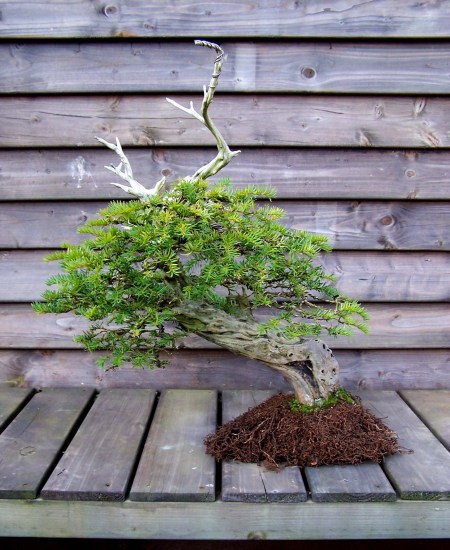
Look how flat the football, consisting of only small feeder roots, is now! This means I can plant it deeper into it's pot and that the tree will look more balanced in it!
Look how flat the rootball is now, consisting of only small feeder roots! This means I can plant it deeper into its old pot and that the tree will look more balanced in it!


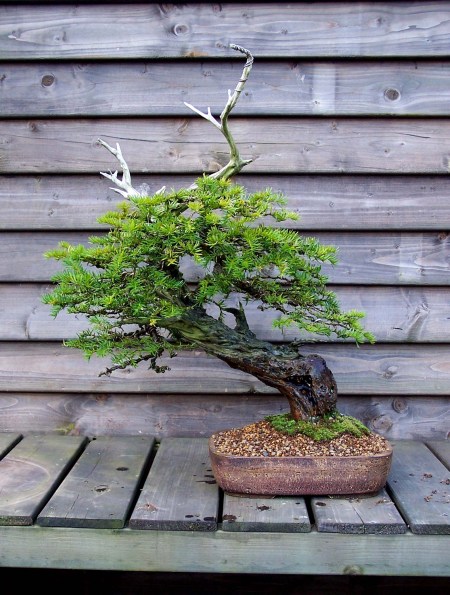
Here the tree is back in it's old pot, as soon as it is settled down and showing lots off new growth, I will start to wire it again and bring it back into its desired form. I am glad this tree recovered from it's ordeal so well, it holds a lot of good memories for me!
Here the tree is back in its old pot, as soon as it is settled down and showing lots of new growth, I will start to wire it and bring it back into its desired form again. I am glad this tree recovered from its ordeal so well, it holds a lot of good memories for me!

verpotten-12-maart-052-web  verpotten-12-maart-056-web

verpotten-12-maart-057-web  verpotten-12-maart-060-web

verpotten-12-maart-062-web  verpotten-12-maart-067-we

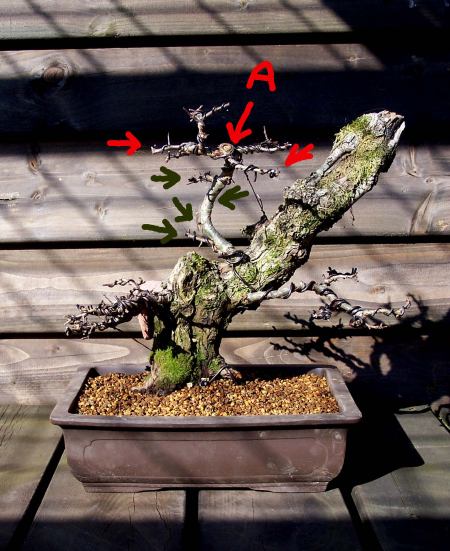
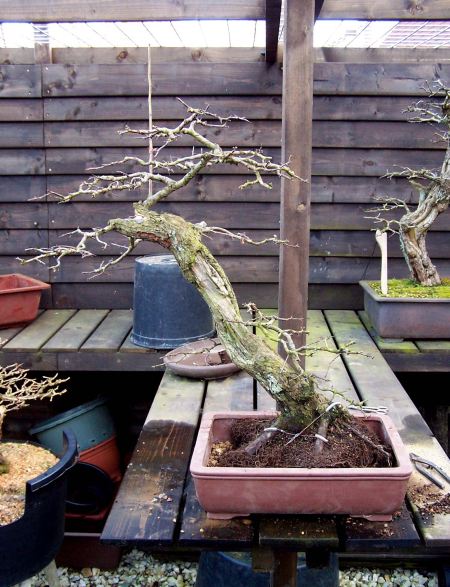
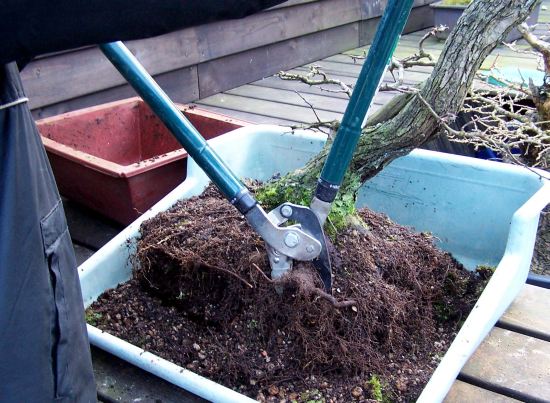
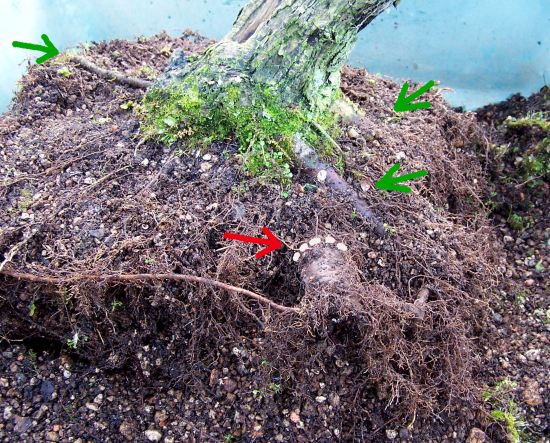
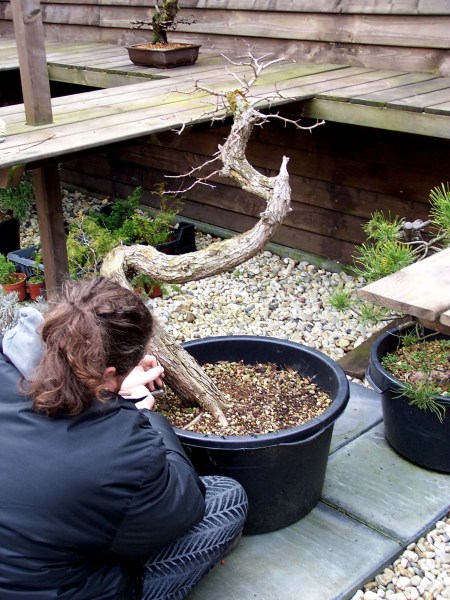
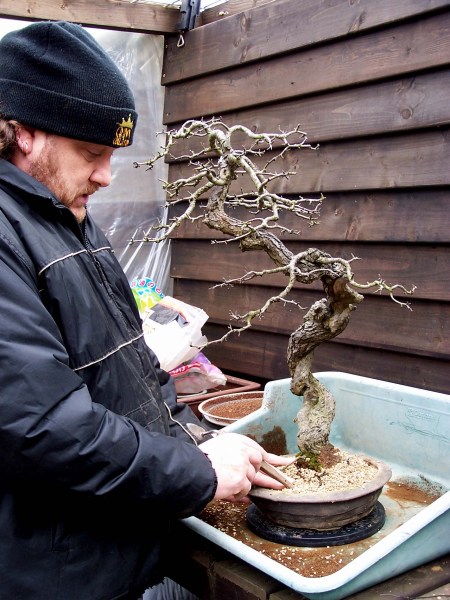
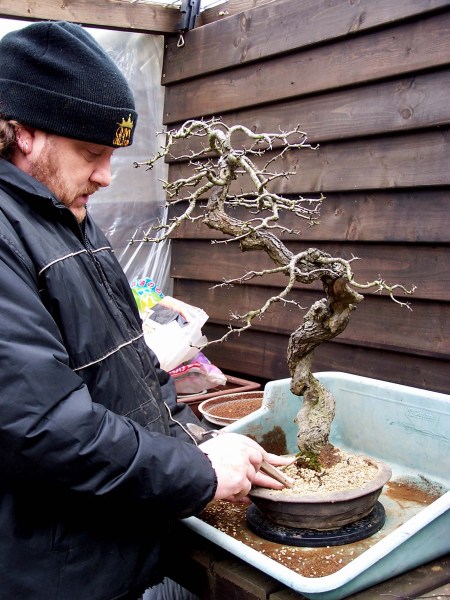
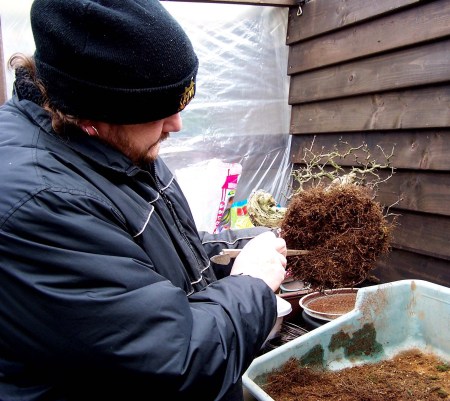
Above: This is the first transplanting for this Dutch “Hawthorn” Yamadori. As you can see the pot is full of healthy roots, so it was safe to remove the too thick root (red arrow) you can see in the second picture. The green arrow in that same picture, show some nice positioned strong roots. The next 2 picture s show how I removed that root. The last picture shows the tree in its new pot for now. For the next couple of seasons, I will concentrate on the growth of the relatively young branches, the need to thicken and mature. And of course, I have to work on the total ramification of the tree. This ugly duckling is quickly becoming one off the favourites trees to work on, in my collection!  A couple of years ago I offered it for sale, still as raw material, during a big convention. For a very reasonable price, but nobody seemed to notice this oddly shaped tree, so full of natural mistakes. There and then, I drew a design on a small piece of paper, and afterwards, I gladly took the tree home with me, to style it myself! I have to admit though, it took a lot off imagination and even some optical tricks. But I seem to have overcome, some major design problems. Creating a thing of interest or even beauty, out of not too good material, is something I really love. Because these trees are not too obvious to style, you really have to look for that hidden Bonsai! But when you find it and everything turns out well, you will have a Bonsai that is often so much more interesting than the prefab ones. I enjoy it when a plan comes together! 🙂
Of course, I know, this tree has a very long way to go, but it is growing nicely into a “Mother and child” tree, with a twist. The mother leaning into the wind, protecting the little child that clings to her side, from the prevailing winds that torture the Dutch coastline were I actually collected this tree! I will keep you posted.

These roots, on one of my Acer palmatum's, are begining to look nice.
These roots, on one of my Acer palmatum, are beginning to look nice.

verpotten-12-maart-024-web  verpotten-12-maart-029-web

verpotten-12-maart-032-web  verpotten-12-maart-035-web

Above picture: This small tree is also a Dutch “Hawthorn” Yamadori.

Some serious bending going on.

Before We go any further, I would like to say, I am sorry that this post is dragging on so long. But it is the only way I am able to post anything new on my blog!

Hope you enjoyed it anyway!

Hans van Meer.

Info: karamottobonsai@hotmail.com

——————————————————————————————-

I FINALLY FINISHED THE WORK ON MY PINUS UNCINATA.


Hi, everybody,

Yesterday I finally had the change to finish the work on my Pinus Uncinata. Although it took me a month or so too long to do it all, I am glad about the outcome of my work. The tree had enough growth and new foliage for me to give the image more height and width, I even removed a major branch from the left bottom branch. There was no more need for heavy wire, every main branch is fixated, more or less, in its right place. I tried to create more layers in the separate foliage pads and more open spaces between the foliage, these details create a whole new feeling when I look at it. The tree, now, looks taller and more like it is growing in the distance. I feel this is very important part of the future process of trying to find some sort of believable balance in this extreme Bonsai design I have in my mind for this Pine! The right Jin on the ground is already half cut to give me a better impression of how it will look in the near future! I left it like this because that part of the Jin that is left on is used to tie down the tree to the rim of the pot to hold it upright and secure!

More to come!


*

*

Above picture: I placed the tree in a virtual pot to get a feel of how it will look, in a more upright position. As you can see, the open spaces increased a lot between the bottom branches and the soil level. And that is something to take along in the next restyling session. This is not a pot I would go for, but it will do for this purpose.

I hope you like this old Pine as much as I do,

Hans van Meer.

Info: karamottobonsai@hotmail.com

———————————————————————————————-


REMOVING NEEDLES, BEFORE WIRING, ON MY PINUS UNCINATA.

Hi, everybody,

A few days ago, during a short sunny dry spell, I removed all of the last years and some of this year’s needles. To control and promote growth and to make it easier to wire the branches.

When I feel up to it, I hope to start to wire the tree! This picture is a rare shot of the backside of this old Pine.

Regards,

Hans van Meer.

Info: karamottobonsai@hotmail.com

————————————————————————————————-


THE FIRST STYLING OF ED’S PINE.

Hi, everybody,

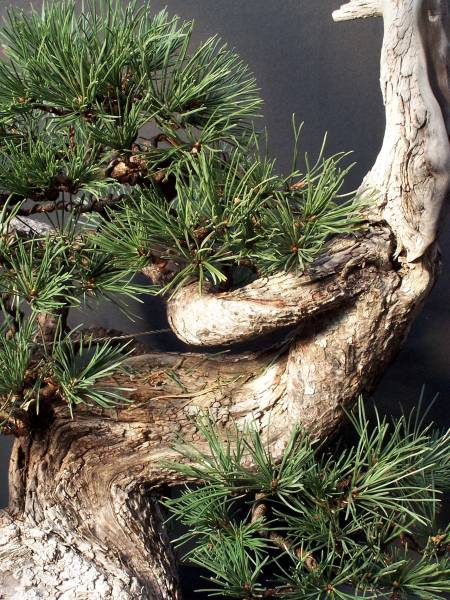
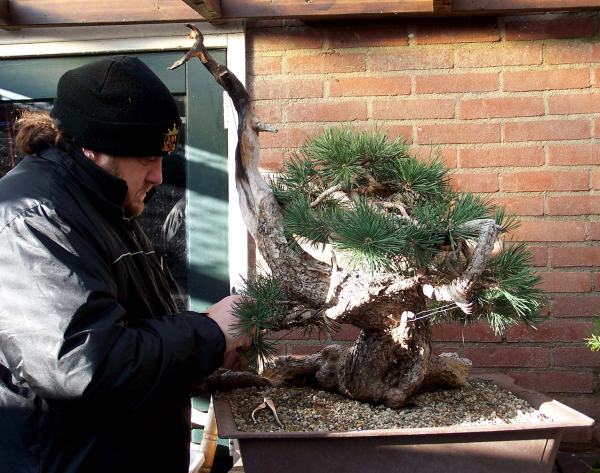
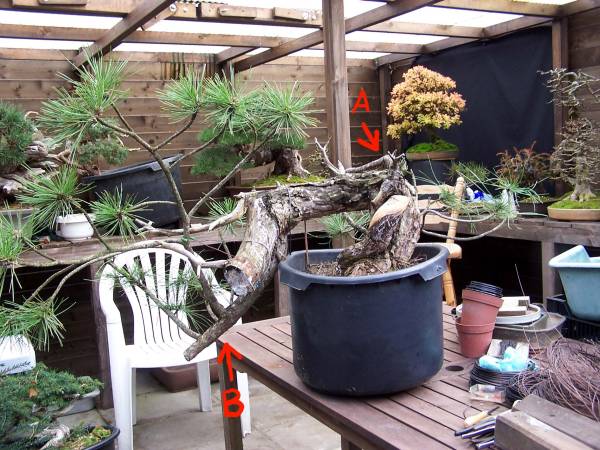
last Thursday my student Ed van der Reek brought his latest find, a Pinus uncinata, to my garden to give it it’s first styling. This small Pine showed all the typical Yamadori futures we look for in good Bonsai material, But on the other hand, it showed just as many typical Yamadori problems, that needed to be solved, or better yet, incorporated into the overall Bonsai design, in a way that would actually make the tree look better. There is a lot of beauty to be found in imperfection! 

More text to the pics will follow tomorrow!

*


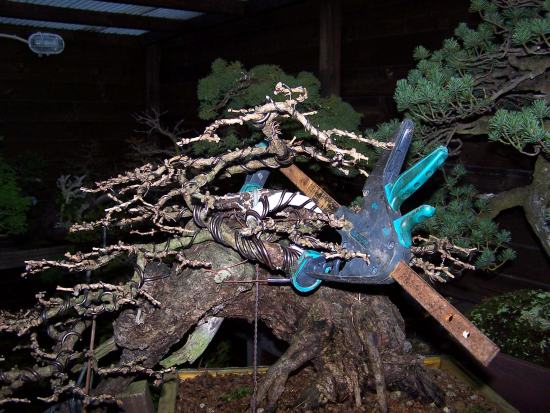
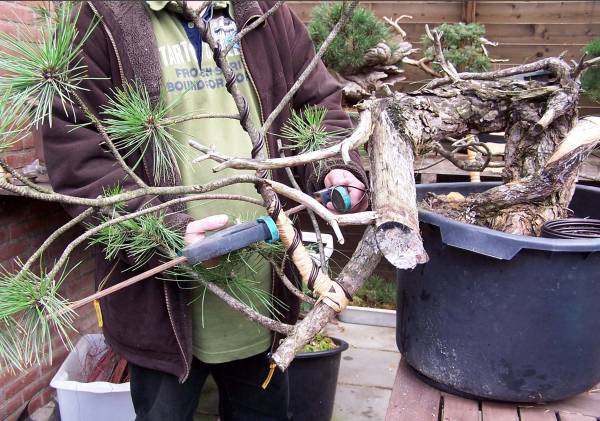
Left picture: Sorry for this poor picture against that bad background. Those two chairs were there for me, I had to go sit down every now and then! Point A:  Shows one of the only 2 branches on the battered Pine. It is a to long branch, that grows from an ugly spot on the back side of the tree. It will be a major problem, to use this weak branch in any design we might come up with! Point B: Shows the second (Cascading) branch. This is a very hard to bend straight and thick branches, from which, way down 3 secondary branches grew. 1 strong and long and 2 smaller and weaker once. Above this branch, you can see a large dead wood stump that needs to be reduced and shaped in the future after the tree has its new image!

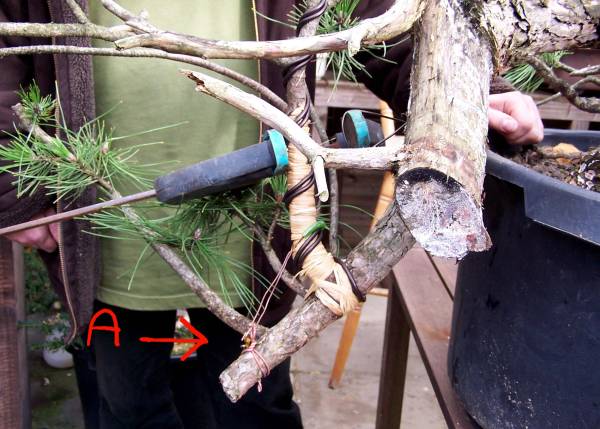
Right picture: A: Close up of the weak back branch.


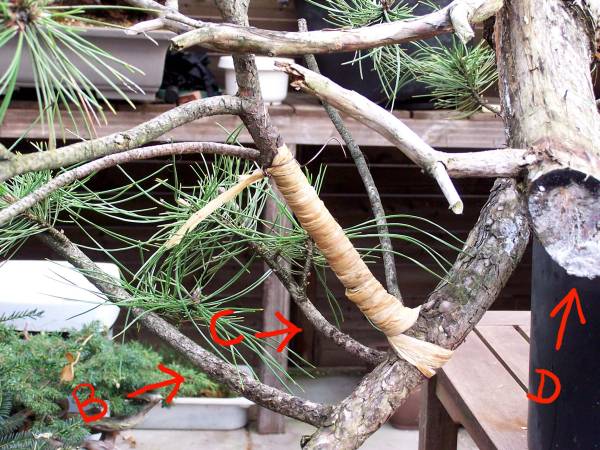
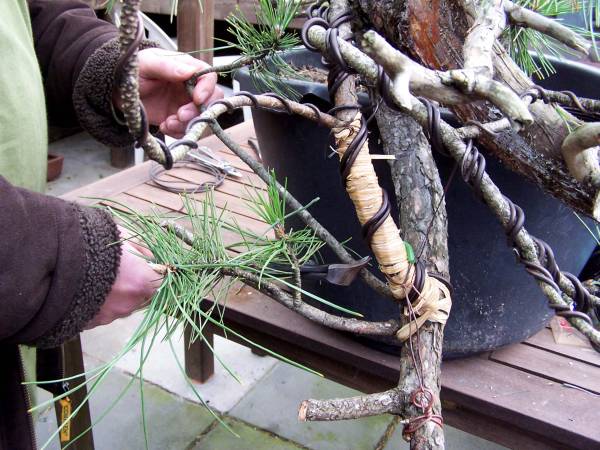
Left picture: Side branches B and C are the weakest 2 of the 3 growing from the main branch, and they are placed to low down. ED uses wet raffia to tightly wrapped the place where the thick branch endures the most pressure when it is brought into the desired position. Than 2 lengths of copper wire are, with the help of pre-cut small pieces of thin wire, placed lengthwise along the side of the outside curve of the branch. The small pieces are there to help you attached the lengths of wire along the side of the branch, even if you work alone. Just hold them in place with one hand and use the other to swing the little piece around the area you are holding and then tighten it by hand and then by pliers. You repeat this process along the rest of the branch, very easy this way and it ensures that the lengths of wire are very tightly bound to the part where the branch needs protection from breaking! Then, as tight as possible, another layer of wet raffia was applied and over that layer normal wire was applied to hold everything tightly into place!

Right picture: A normal wood clamp was used to, very easily, bend the thick branch, bit by bit, into its desired position. The 15 minutes break we took in between the bending of this all-important branch, were used to wire the rest of the smaller branches and to drink some more coffee.


Left picture: Point A: The base of the branch was secured by a piece of copper wire to the dead stump. To prevent it from being torn off at its base! Here you can also clearly see the large deadwood stump that hides most of the main branch. This deadwood needs to be reduced and shaped in the future. In a way that fits the tree design as well as hiding the straightness of that same main branch.

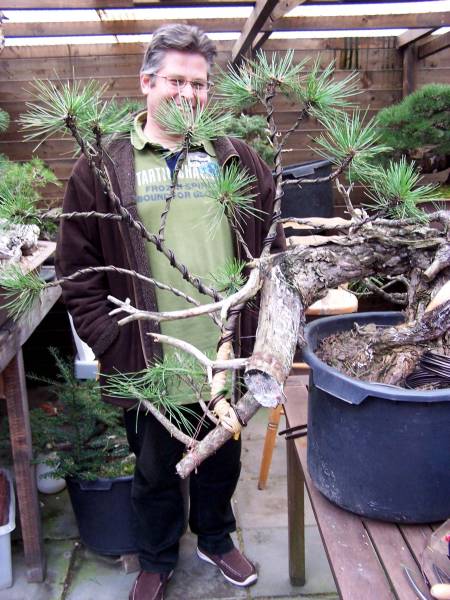
Right picture: WOW! Look how far it has come and without any problems. Ed still can’t believe it! 🙂


Left picture: Side branch B is bent down and appears here from under need the trunk.

Right picture: Here Ed is carefully bending the cascading (side) branch into position.


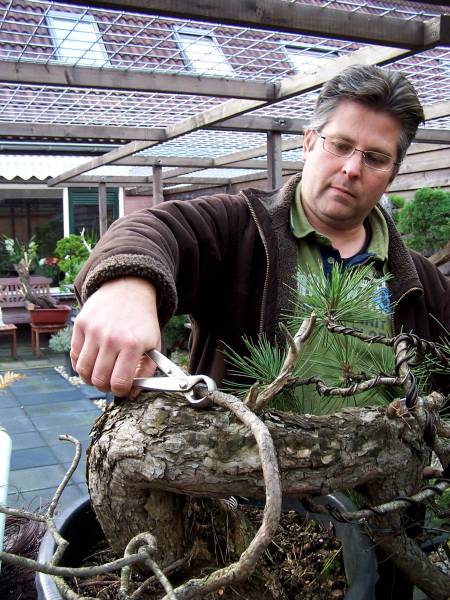
Left and right picture: The now useless side branches are removed by Ed.


Left picture: without hesitation, Ed removes the useless branch on the right (back) side of the tree. Leaving a stump for a future Jin.

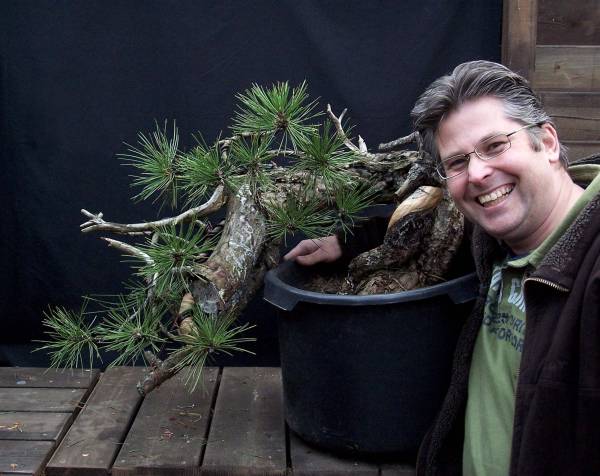
Right picture: After an afternoon of fun, Ed can really smile with the outcome of his work. The deadwood carving will be don later when Ed is more used to the trees new image. He has to charge his fantasy first for a while, so to speak. I am sure this tree will turn out just great in the future!

Most of the times I make a drawing, but this time I made this virtual of this future Bonsai for Ed. There are no back branches visible in this drawing, but there are 3 of those in the real design. Out of experience with my own trees, I have learned, that when the proper technique to stimulate back budding are applied on these Yamadori Pines, a design like this can be visual in 7 to 10 years. I know it sounds like a long time, but every step in the life of a Bonsai is worth taking, believe me!  

Ed is happy so I am very happy, so it was a good Bonsai day again!

Regards,

Hans.

Info: karamottobonsai@hotmail.com

————————————————————–