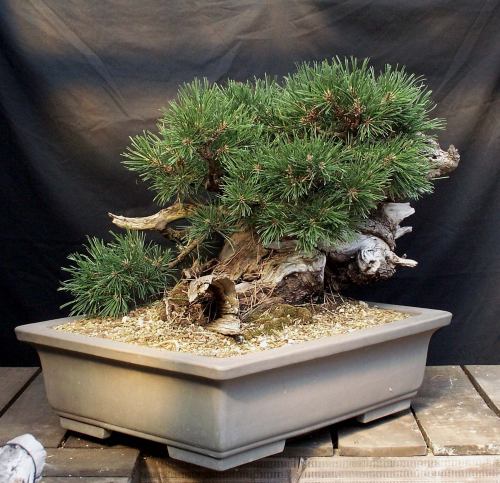
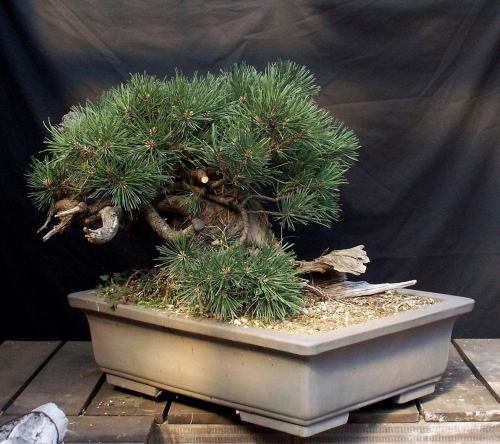
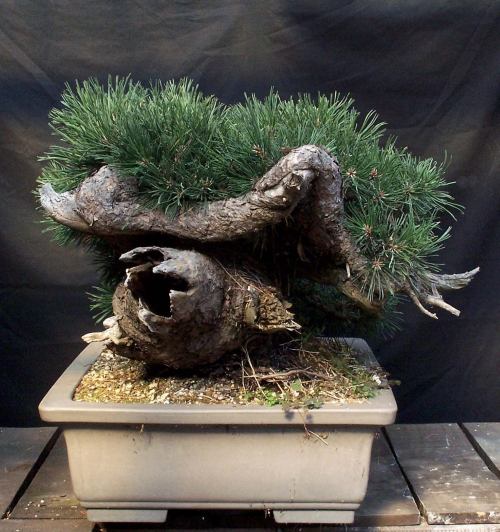
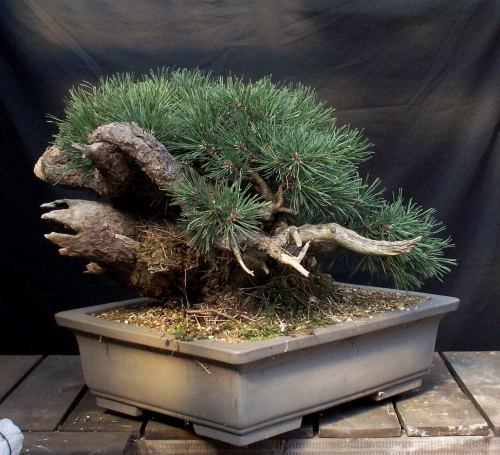
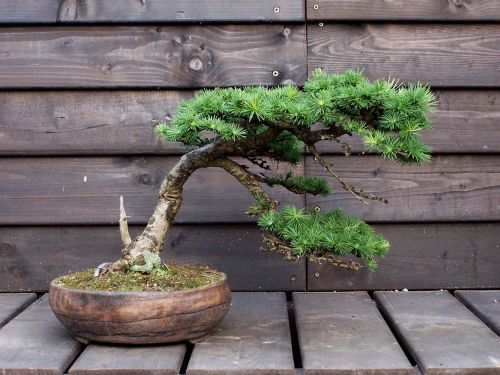
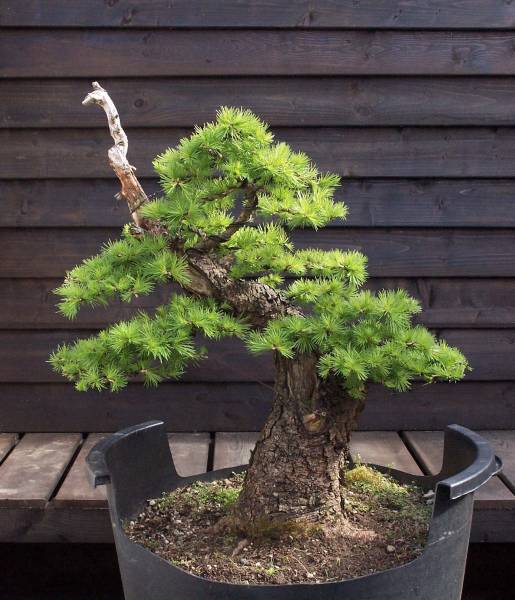
Some Lazy Sunday Work On A Acer Buergerianum.

Hi, everybody,

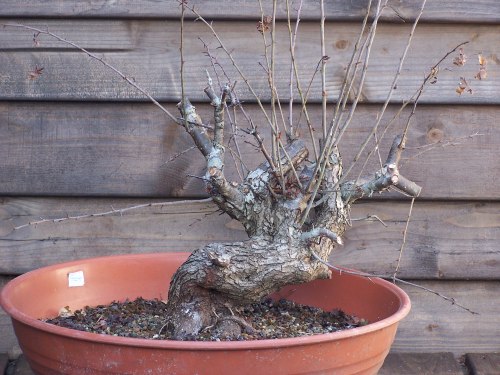
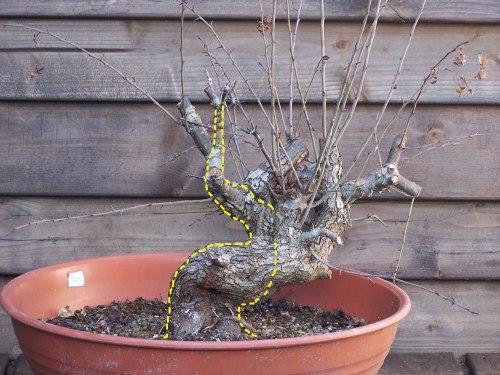
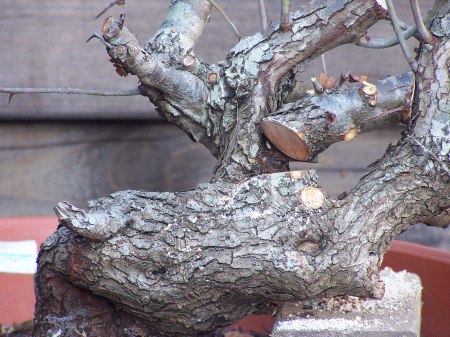
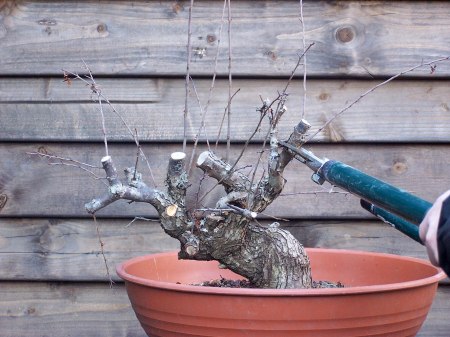
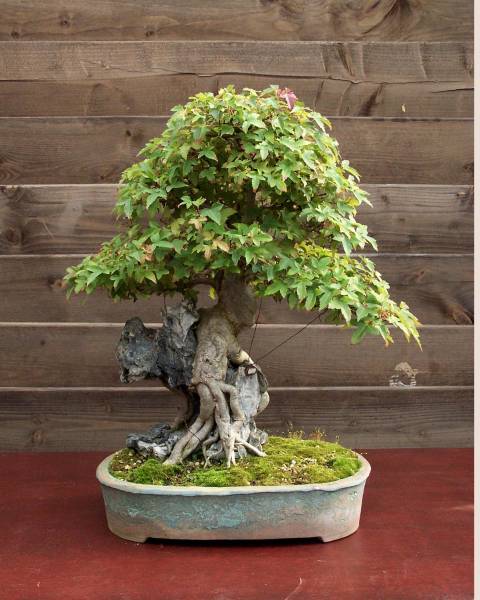
I did a lot of joy full Bonsai work on this unexpected Sunny Sunday afternoon. Just little things, here and there. Some cutting, some bending, some cleaning of old needles and leafs, just the fun Bonsai stuff on a perfect lazy afternoon. One of the trees I worked on today was the Acer buergerianum in the picture below. This tree is more than 12 years under my care now and during that long time, it was always one of my favourite projects that came along nicely. When I bought the tree, it had just a few little and ugly placed and deformed branches. And a lot of ugly scares from bad wound treatment! So I worked all those years towards better ramification and everything looked very promising until 3 years ago! During that winter, the tree lost 1 important branch and most of it smaller ramification! So its image was destroyed!

But with a lot of love and care, the tree recovered and today again shows a lot of healthy growth! It those needs some more small branches and finer ramification to get to the image I have in mind. But I am already very happy to see that the tree is willing to give me a second chance, it made me smile! I hope you like it?

Cheers,

Hans van Meer.

Info: karamottobonsai@hotmail.com

—————————————————————————————————

A UPDATE ON THE “SWAN”.


Hi, everybody,

27 July 2008

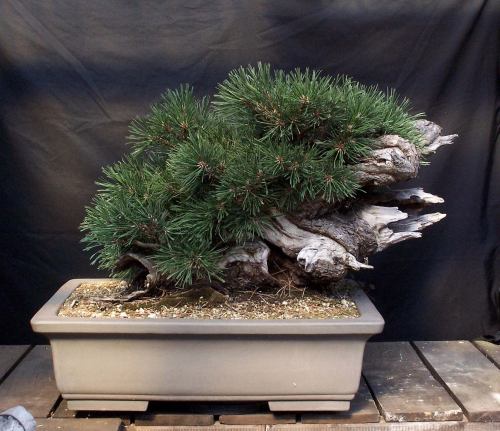
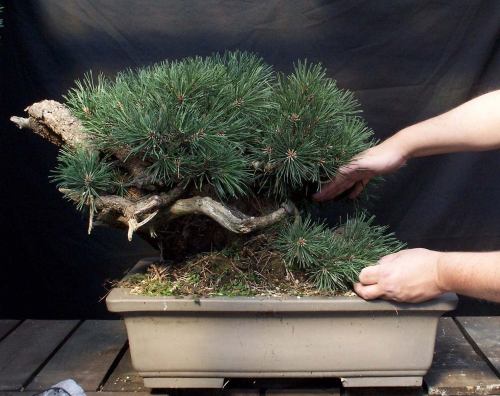
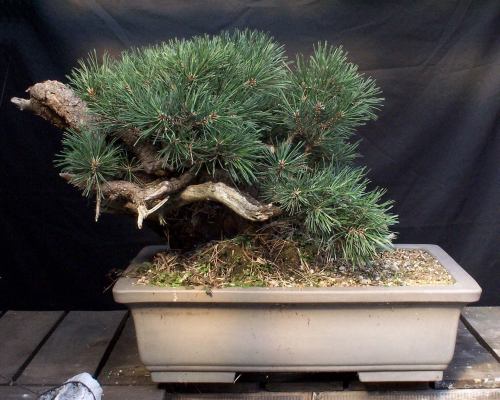
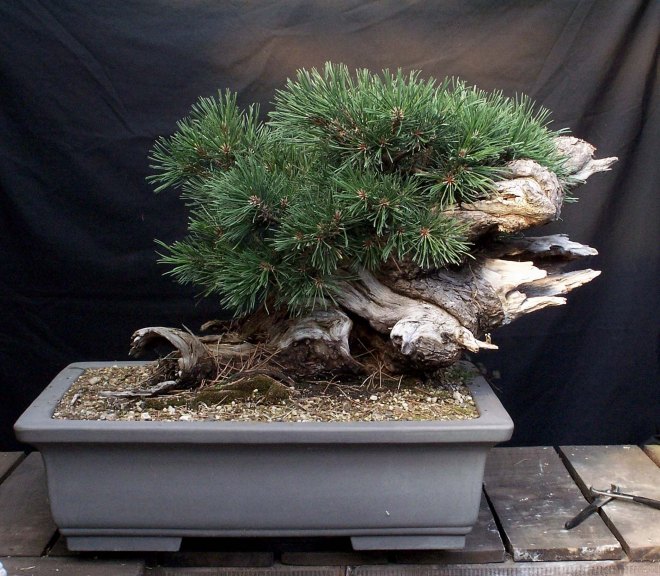
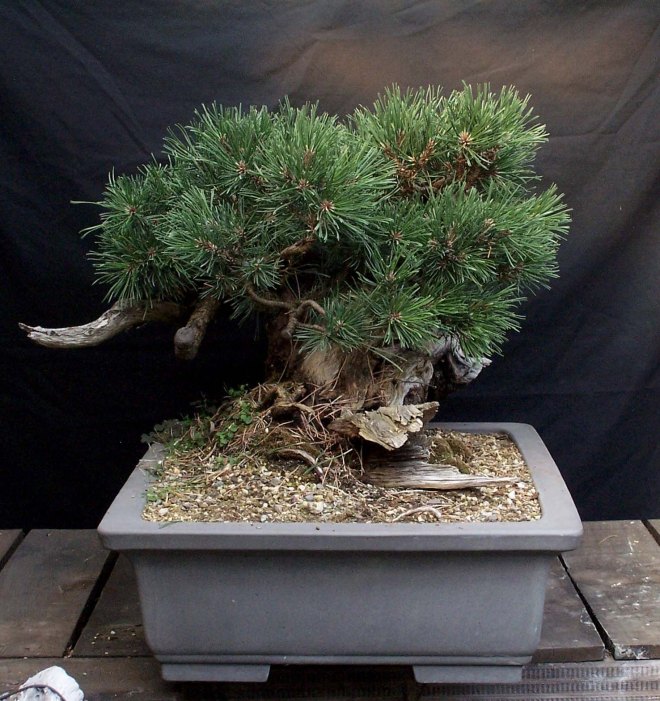
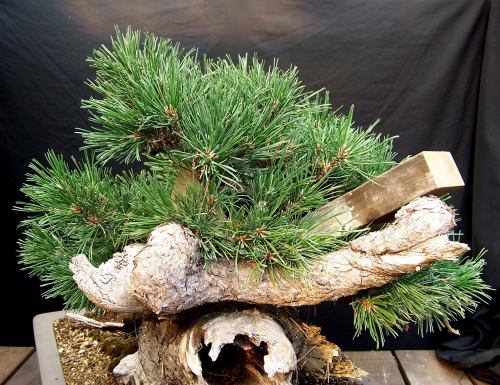
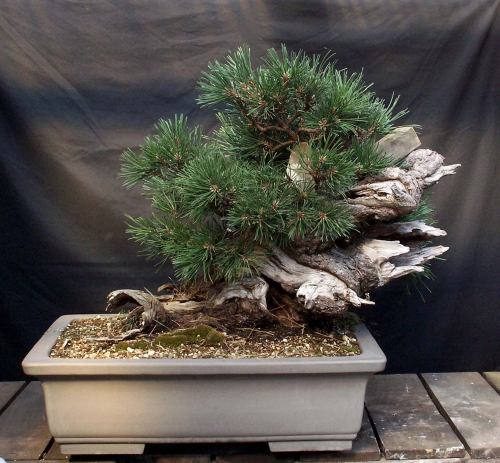
Above picture: The last major work that was done on this old Pine dates back to its first styling in *2004! All this time up to now, the tree was pampered to encourage back budding as close as possible to the trunk line. Well, as you can see, I got more than enough new foliage and buds to give the tree it second major styling in late fall this year! But there were some major decisions to be made right now as well!

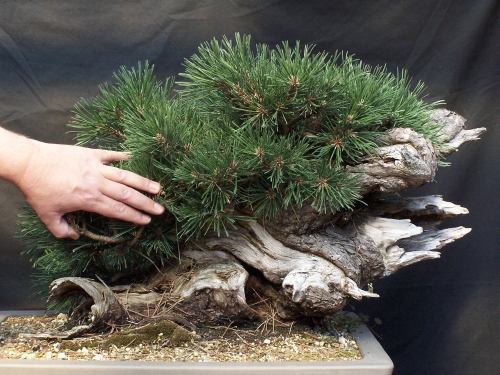
In the first styling, 2 back branches were used to build up the lower left front section, so I could visualise and check my vision of the future bonsai. But now, because of all this incredible growth, I have so much more better-placed branches and foliage to replace them with, that they have become unnecessary. In the above picture, where I raise this frond branch, you can see just how much beautiful deadwood was hidden from view!

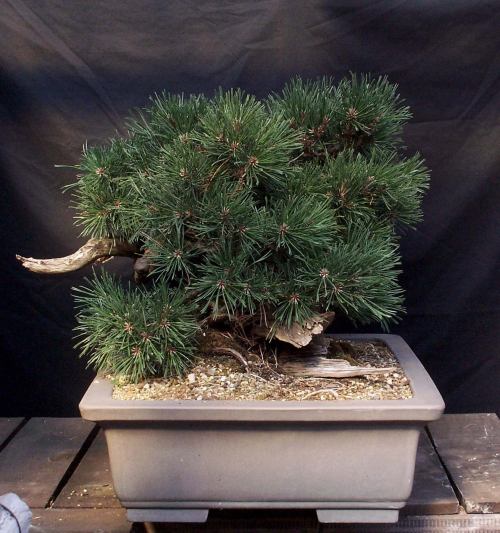
Above picture: Left side view of the tree, you can see just how much deadwood is blocked from view.

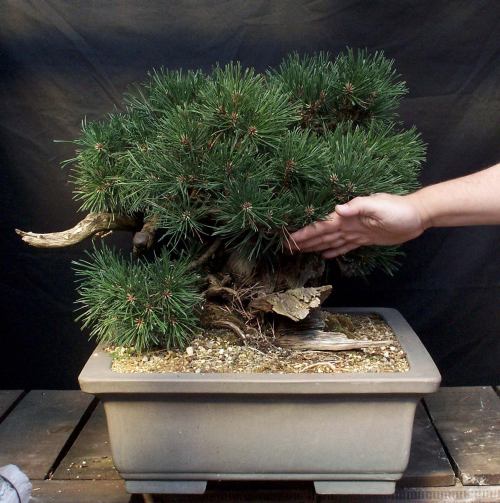
Above picture: Lifting up the heavier frond branch makes a big improvement. You can see the other branch that has to go, on the left of my fingertips.

Above picture: Here you can see the second branch better. It is blocking out all the empty backspace, that you need to see from the front side.

Above picture: Here you can clearly see the difference it makes when I lift it up!


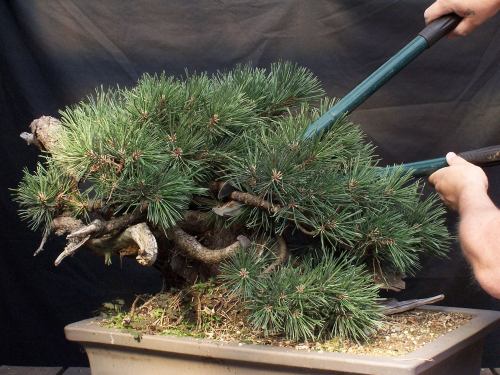
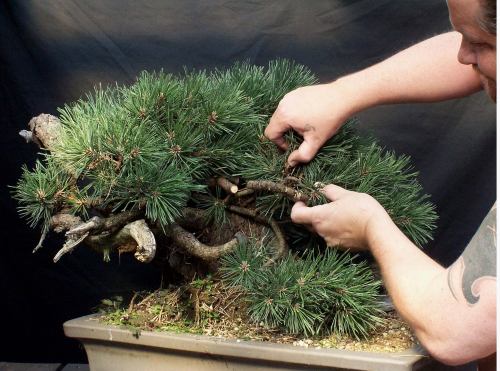
Above picture: This is the thick branch I need to remove first. Under need it, you can see the second one that needs to go.

                            Above picture: Judging were to cut that branch.

Above right: Heavy cutters were used to cut off that branch in one go.

                                Above picture: So, the first one is removed!

                            Above picture: Looks better already from the front.

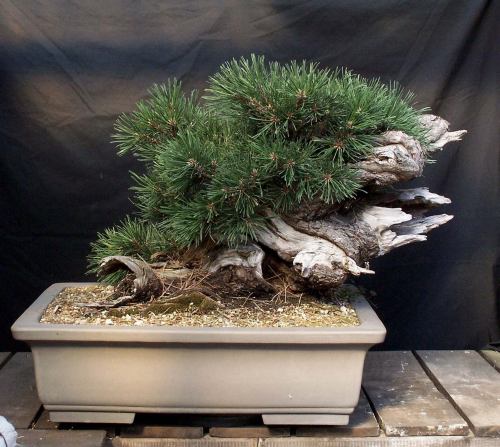
Above picture: You can see clearly here, that when we now stand in front of the tree, there is almost a clear pathway under need the foliage, for the eye to wander off into the distance.

Above two pictures: Yes, that branch definitely has to go to!

                             Above two pictures: Right and backside view.

                                                 Above picture: Backside view.

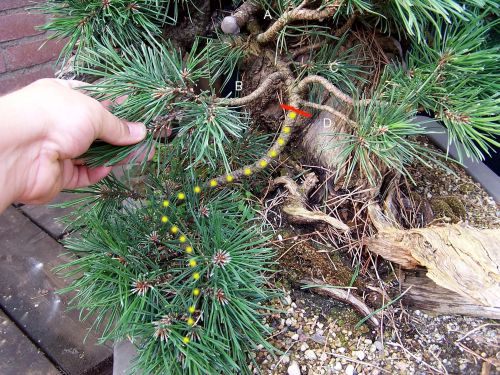
Above picture: The yellow dots show how long this branch really is. Because of the constant cutting back into new growth and pinching back that I did in the seasons after it’s first styling, the 3 small branches, just above the red line, have grown enough to now be used as the new branch tips of the future first branch.

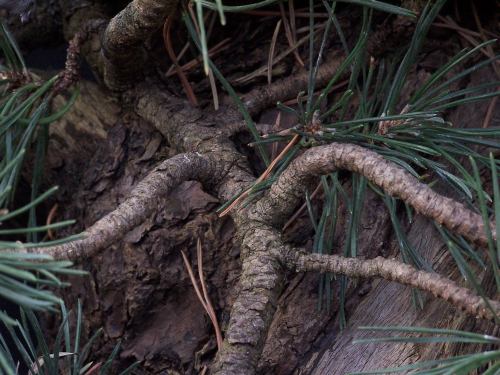
                           Above picture: Close up of those 3 small branches.

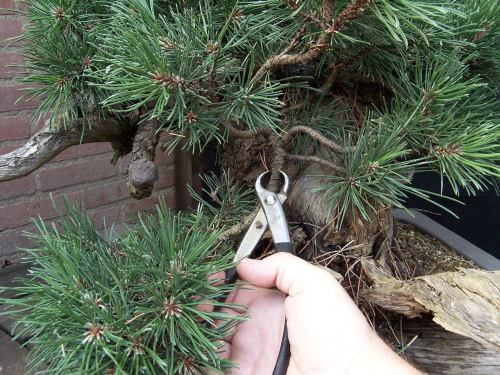
Above picture: The branch is cut leaving a small stump so that there is enough room for it to dry back naturally, without harming those all important small branches.


                       Above picture: The wounds are sealed with cut paste.

                                  Above pictures show the removed branches.

Above pictures show, that by just removing those two branches the beautiful deadwood is more open. The open space that now is created, provides the necessary see trough, that creates dept and open space under need this future first branch.

Above picture: With the help of 2 wooden blocks, some branches were lifted, so that light and air can better reach the inner buds and smaller branches that I need for my second styling.

Above picture: These blocks created new height in the foliage and a new image!

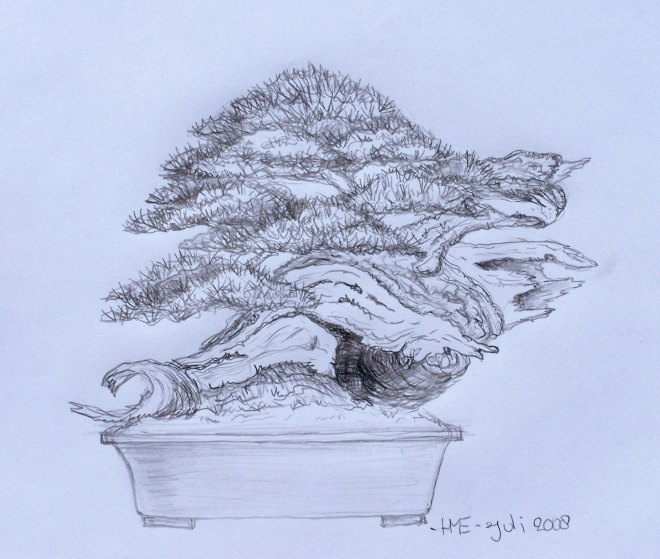
Below picture: So that triggered me, to make a quick drawing of a possible design. Having done this, I realise that the foliage is too high in this new idea and that the tree image should be more compact. So this drawing helped me to decide to stick to the original plan I made when I started to style this tree.

Now the tree is left alone until I will start the second styling in early Winter. I can hardly wait for that time to arrive!

Cheers,

Hans van Meer.

Info: karamottobonsai@hotmail.com

—————————————————————————-

UPDATE ON “THE ELEPHANT”.

22 Juli.

Hi, everybody,

although it is not much of a summer right now here in Holland, it has been raining for weeks on end, this is usually a slow period in bonsai. But still, important tasks have to be done regularly, like checking all your trees, to make sure that the wire is not digging into the bark. My Larch “THE ELEPHANT” has been wired in late winter, but has grown really a lot, so the wire was starting to cut in, especially in the fast-growing top section. Some off the ticker wire that was holding the top up in place, was already cut off a month ago, that’s why it looks a bit collapsed in this picture. Yesterday my student/friend Ed came over to help me lift this monster to a place where I can remove all the wire more easily! Today it is lovely weather so I don’t mind doing that at all. I shot this picture 2 days ago and I hope you like the progress of “THE ELEPHANT” so fare? I am off to cut some wires now!

Cheers,

Hans van Meer.

Info: karamottobonsai@hotmail.com

—————————————————————————-

DUTCH YAMADORI “HAWTHORN” DEADWOOD.

Hi, everybody,

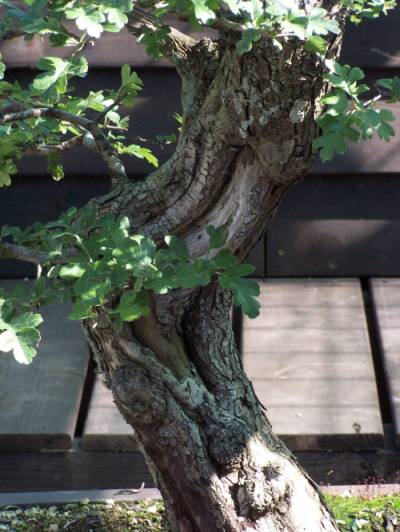
 Here is a close up of the natural deadwood on my Dutch Yamadori Hawthorn that I shot on 20 Juli. Dutch Hawthorn Yamadori Bonsai are rare and even rarer are Dutch Hawthorn Bonsai with natural deadwood! Our circumstances are just not suitable for creating deadwood! This is probably one of the few ones with deadwood that is collected below sea level…making it even more unique! 😉

Info: karamottobonsai@hotmail.com

—————————————————————

LIVE AND DEATH, BEAUTY IN STRUGLE.

Hi, everybody,

this Larch lost a lot of its branches during an unusually long period of extremely hot weather in early Summer 2 seasons ago. So last year I repotted it in a (to) large pot, so it could regain its strength and it did. I left the dead branches on the tree because they actually tell the story that I was meaning to show in this creation from the start. An image of an old tree high on the mountain, bettered by strong winds, snow and dry head during the short summers. Almost falling into the debts below it, but still clinging on to the rock’s, not willing to give in!

I hope you like it,

Hans.

Info: karamottobonsai@hotmail.com

—————————————————————————-


“PEE PINE”


Hi, everybody,

I would like to share the picture I made this afternoon of my small 35cm/14inch  Pinus sylvestris, that I found and collected In Austria in May 2004. Well, that I found, is not completely true! My wife actually drew my intention to this tree first! We were taking a well-deserved rest after a long climb up one of the many beautiful mountains surrounding the cabin where we stayed that week. And while my wife was enjoying the magnificent views, I  took the opportunity  to get rid off some excess water that  I had drunk so much off along the long way up (if you know what I mean?) I was just taking my position, when my wife said “you might want to lift your left foot” ?! I looked down to discover that I was standing on a small Pine, that I totally had  not knottiest,  because of  the high grass it grew in. So now you know why it is called “PEE PINE”! I collected the tree without any problem and it has been growing well ever since.This small tree has wonderful old bark, for such a small tree and a beautiful old “Shari” running along most off its trunk. Off course,  this tree needs more years, for the branches to mature and to reduce the needle size, bud I am already pretty pleased with the image this small tree suggests. I hope you like it?

Hans van Meer.

—————————————————————————-

                                                                 “PEE PINE”  

Info: karamottobonsai@hotmail.com

—————————————————————————-

UPDATE ON MY LARCH NAMED XL.

Hi, everybody,

14-04-2008. I love the subtle image changes this old  “LARCH” has gone through the last couple of weeks.

Cheers,

Hans van Meer.

Info: karamottobonsai@hotmail.com

—————————————————————————–

————————————————————————————–

“BIG RON’S” FIRM GRIP!

Hi, everybody,

Today, After I finished the last floor/groundwork in the back of my garden, I could finally place “BIG RON” in his rightful place. The fading spring sunlight gave the tree a beautiful glow, so I quickly shot some pictures. The next Photograph, that shows the firm grip of the roots is one I particularly like! I hope you like it too?!

Hans van Meer.

Info: karamottobonsai@hotmail.com

————————————————————————–

————————————————————————————-

THE STORY OF THE “ELEPHANT”.

Hi everybody, http://www.karamotto.org/

I would like to let you all know that I have posted new parts of the story about this old Larch on my website:

click on “BONSAI STORYS” and select “THE STORY OF THE ELEPHANT” Regards,

Hans van Meer.

februari-2008-832-hans-van-meer-klein.jpg

                                         “THE ELEPHANT”

Info: karamottobonsai@hotmail.com

——————————————————————————————————–

A short “Crataegus” story.


Hi, everybody,

in November 2006, my dear friend Tony Tickle invited me to come to England to do the (now famous) all weekend “BURRS” workshop. I arrived a few days before all that fun would start because Tony would take me and Morten into the beautiful “Wells” mountains for a walk and to try to find some collectable “Crataegus” yamadori. Well, I got very lucky when I discovered a small one with a lot of potential! I have no pictures of the actual collecting of the tree, but this is the view from that same place where the “Hawthorn” of this story was found and without much trouble collected by me.
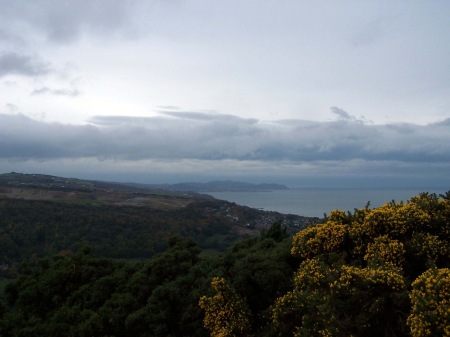
burrs-uk-2006-033-hans-van-meer.jpg

She grew on a steep mountainside in soil, consisting of almost nothing else than small rocks and gravel, from which I could almost entirely collect her with nothing more than my bare hands (that looked and felt like they had been looking for a pin in a pin stack)! Never the less, she had managed to grow surprisingly good roots, with a lot of small feeder roots growing close the base of the trunk. So I could cut the to larch roots back without causing to much harm to the health of the tree. From experience, I know that next Spring the tree will react to this hard root and branch cut back, with much growth of small feeder roots, that will secure the health of the tree, during this time it is recovering from the stress caused by collecting it and potting it. As soon as the tree was lifted from the ground the bare roots were wrapped in wet sphagnum moss and then put into a plastic bin bag that was tightly wrapped with plastic tape. Early next day at the venue in “BURRS” my good friend Terry Foster helped me to plant the tree in a plastic training pot, making sure that the tree was firmly secured to the bottom with aluminium wires. The Hawthorn stayed in Tony’s care during that winter. He placed the tree in his greenhouse on a heating bed. In February the following year, Tony came, just like me and many others, to the “Noelanders trophy” in Belgium to show his Bonsai and to meet up with all our bonsai friends from all over Europe that come there every year as well. He kindly brought along my Hawthorns I collected and so after the show they finally came home with me to my little garden in Holland. The Hawthorns ( I collected two) were placed in my greenhouse for protection during the rest of that Winter. In Spring I was delighted to see that the trees literally burst out with new buds all over. I removed all the buds that were unnecessary for my design from the trunk, simply by rubbing them off with my fingers. Leaving unwanted buds to grow will take the strength away from other more important buds and will leave unwanted scares in your trunk. The tree was allowed to grow freely the next growing season, in a semi-shaded place in my garden. In the next picture from August that year, you can see that she was doing really well and I knew then that I could safely give it here first styling at the end of the winter before the buds start swelling.
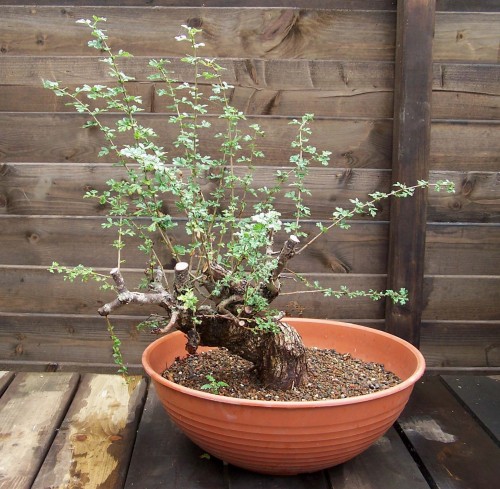
1-augustus-076-hans-van-meer.jpg

    And this is how the tree looked in February 2008 before the work started.
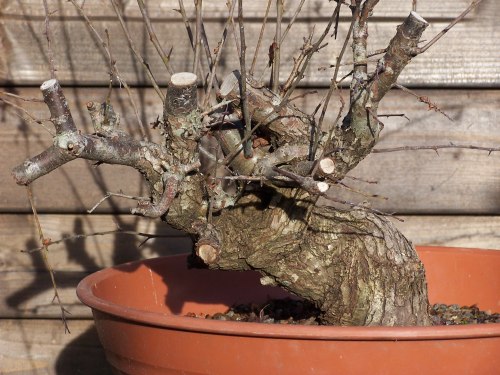
februari-2008-127-hans-van-meer.jpg

OK, before I start to work: have a look at the next two pictures of the front and back of the tree and try to discover the future  design I discovered in this little “Hawthorn”
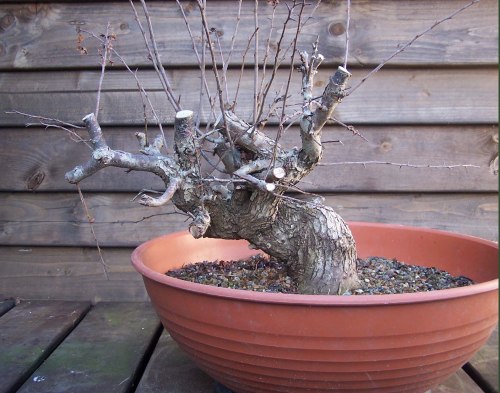
                                Have you found it? This is what I have in mind:

To reach this ideal profile or frame, I had to do some major branch cutting! Always trying to leave as little wounds as possible, where there was no room for some deadwood/Shari on the trunk.  

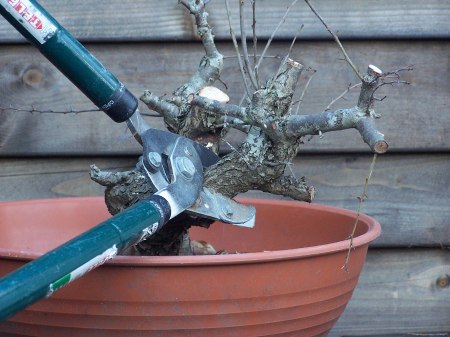
As you can see in the pictures below, the yellow cuts were not much of a problem to do, but the red cut was a bit harder to reach with cutters or normal saw!  
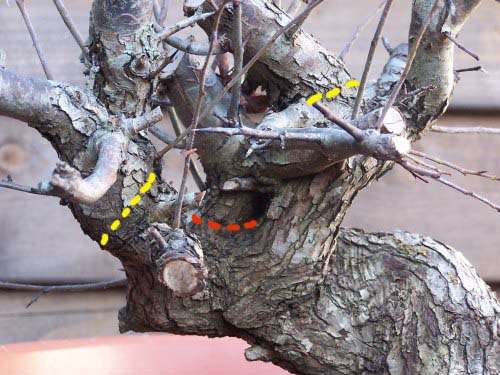
 

First, all the excess branches were cut off, so I could get a  good firm hold on the tree, while I was sawing away, without pricking myself a thousand times! Then, with the help of a very sharp small bladed woodcutters knife, that is used by foresters, I was able to remove the thick branch in one go.

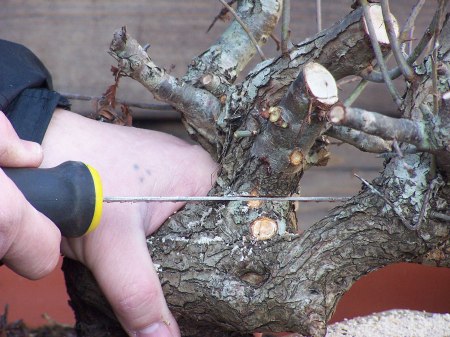
 Then one by one and bit by bit all the other useless branches were cut back.
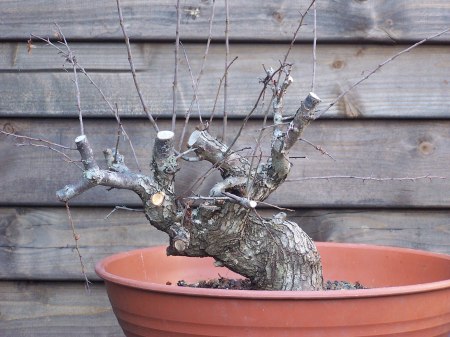
A  large branch cutter, like  I use here, is a priceless tool for this kind of work! It makes a clean cut in one go, without placing to much sideways force on the tree and roots, like a saw or power tool does. No matter how good you think you hold the tree in place!
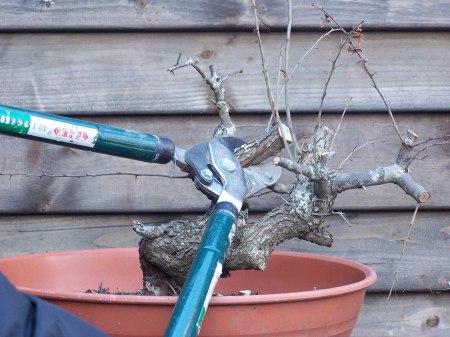
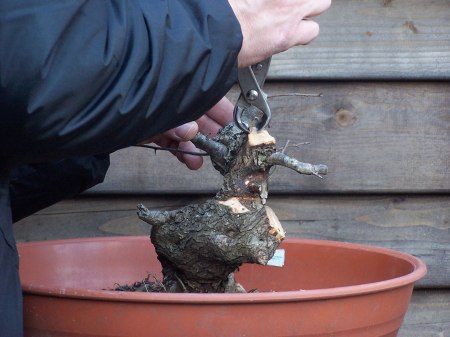
Slowly, with every cut, the new shape of this tree is revealed! All wounds are worked over with concave cutters to promote better wound healing. So that in a few years,  the tree is left with large, but natural looking scares, that can be seen on every Hawthorn here on the coastline.

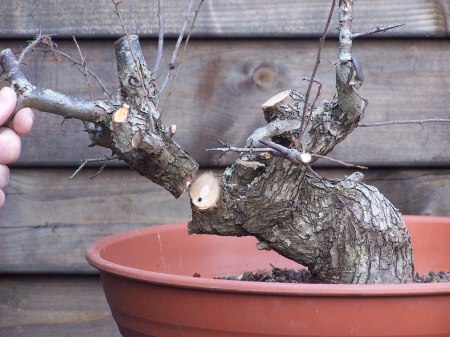
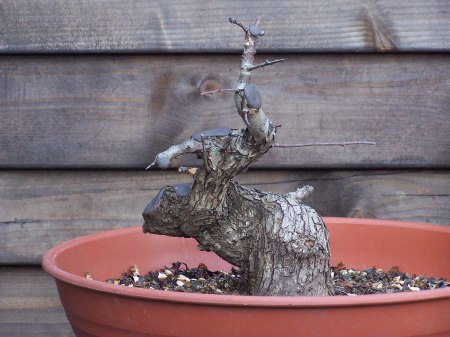
After all the wounds were cut back sufficiently, they were sealed with cut paste. The large wound on the left of the tree (middle picture) is cut back to about 2,5 cm/1 inch of the truck. In the future, this stump will be worked into a small Jin + Shari or maybe only a   Shari? But this work is left for the future! Because doing it now and then leaving such a large open scare, right on the trunk line, could cause die back in the trunk! Every large wound that is left exposed to the elements; will dry/die back,    interrupting the sap flow between roots and branches! Which could kill your branches and roots or even your whole tree! Because I left the bark on this little stump, it will stay alive for a long time, preventing the possibility of trunk die/dry back!  The tree will probably even throw out a bunch of strong shouts along the rim of the wound, the tree’s own bandage! A sign the tree’s sap stream is pumping along the wound. Only after the tree has shown these signs of full recovery, will I start to take that stump away, bit by bit.
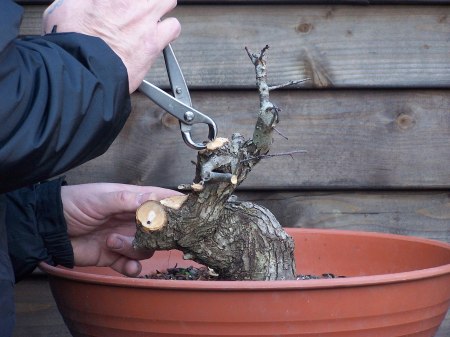
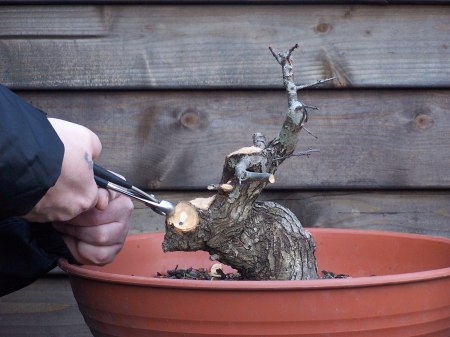
Below: Now only the top needs to be shortened right above the second right                              small branch leaving some room for the die/dry back! 
februari-2008-352-hans-van-meer.jpg

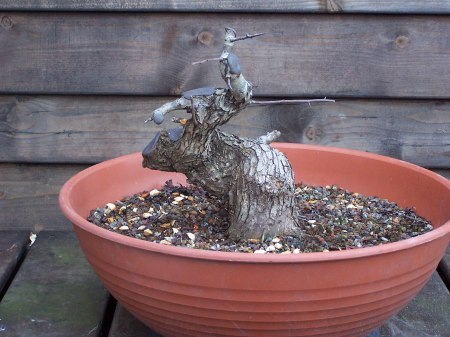
For now, I’m really pleased with the outcome of this little Hawthorn, I love it’s movement and bark texture. I am really looking forward, to next season to see where all the buds will appear! If I’m lucky they will grow just about where I need them.  And if not….who cares? Together, we will think of something.

I hope you liked what I did so far? And I will keep you all posted on this little tree’s progress.

Regards,

Hans van Meer.

Info: karamottobonsai@hotmail.com

—————————————————————————————————–