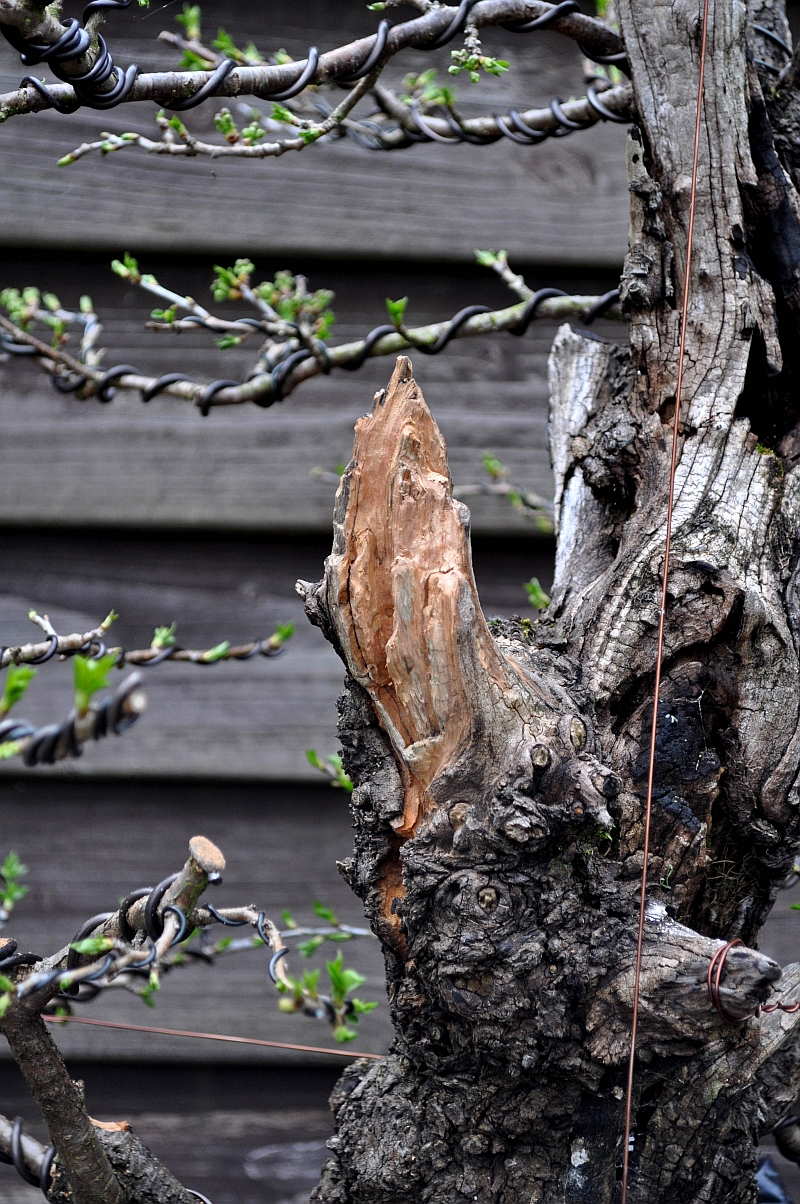
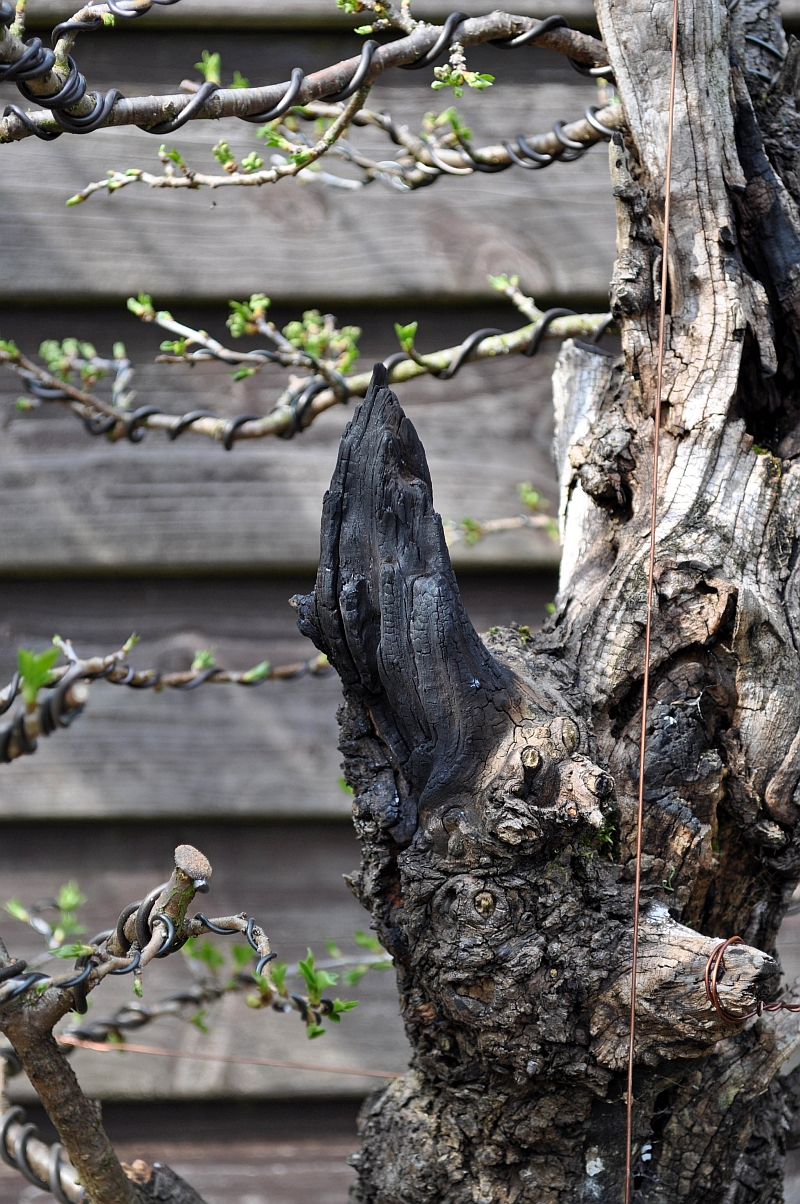
Never ever wash out the soil of a healthy Pine!

Why? Because then you will also remove all the Mycorrhizae Fungi that your Pine needs so hard to survive! Why this warning? Well, a few weeks ago I came across a Bonsai care video on YouTube by a very popular online Bonsai amateur who advocated and then showed how he with a water hose removed all the soil together with the O SO valuable Mycorrhizae from his Mugo Pine?! Giving a lot of newbies that watch his channel completely the wrong and harmful information!
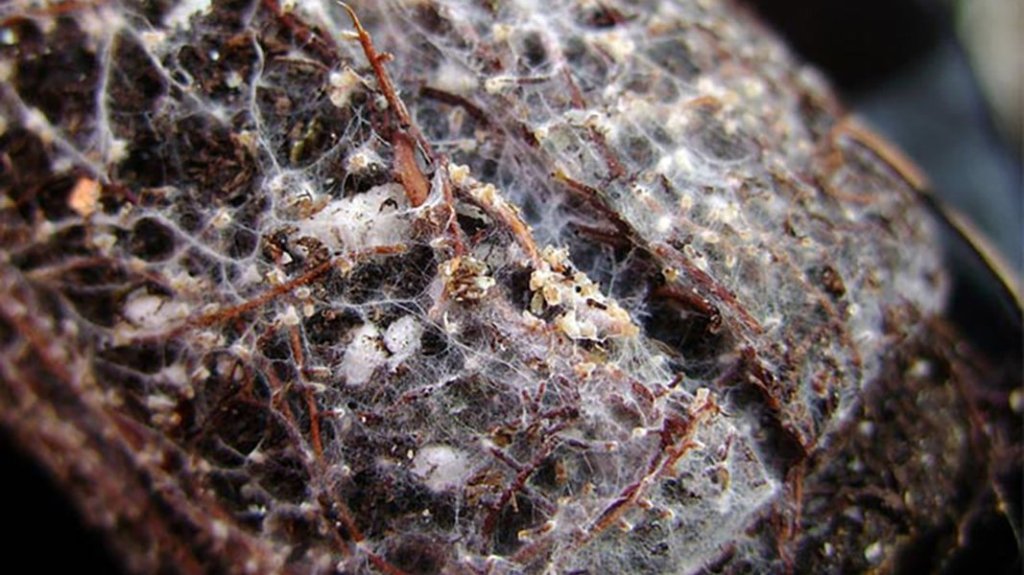
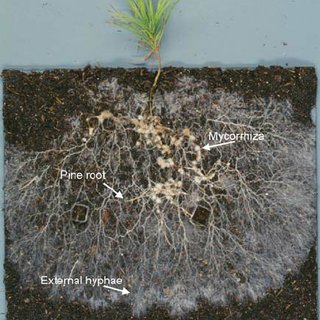
What are mycorrhizae and how do they work and help our Bonsai to grow healthy?

Mycorrhizae are actually a fungus. They exist as very tiny, almost or even entirely microscopic, threads called hyphae. The hyphae are all interconnected into a net-like web called a mycelium, which measures hundreds or thousands of miles—all packed into a tiny area around the plant. 99.9 per cent of all plants live together with Mycorrhizae and benefit from it!

In nature mycelium of a single Mycorrhiza, in turn, can extend outward, connect multiple plants (even plants of different species!), and even connect with other Mycorrhizae to form a Frankenstein-like underground mash-up called a common Mycorrhizal network.

In a common Mycorrhizal network, it’s hard to tell where one mycorrhiza ends and another begins. Because of this vast network, a single plant can be connected to a completely different species of plant halfway across a forest!

Mycorrhizae actually connect to plants in two ways. One form, called ectomycorrhizae, simply surrounds the outside of the roots (e.g., Pines). Another form, called endomycorrhizal, actually grows inside of the plant—their hyphae squeezed in between the cell wall and the cell membranes of the roots (sort of like wedging themselves in between a bicycle tire and the inner tube).

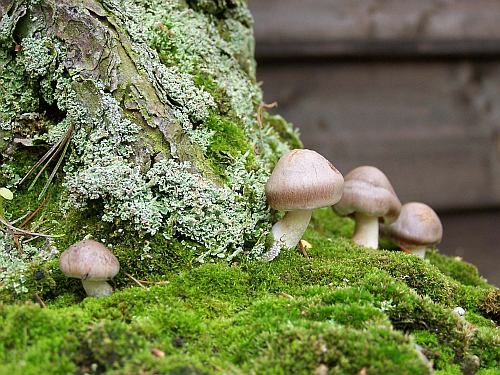
Under normal conditions, you’re not likely to see Mycorrhizae because they’re so small. But every once in a while, something amazing happens: the Mycorrhizae will reproduce and send up fruiting bodies that produce spores—we call them mushrooms and they can sometimes even be seen growing in our Bonsai pot next to a Pine! Some of these mushrooms are even edible, like truffles or chanterelles.

Below: This pretty Picture from late September 2009 shows some beautiful harmless mushrooms growing between the roots of my old Chinees Pinus parviflora (white pine)! They can’t do any harm as long as they don’t grow from in between the live bark or on your deadwood! This old friend has not been repotted for some 7 or 8 years now!
How do plants help Mycorrhizae?

Plants make great gardeners. Just like we fertilize our gardens, plants feed their own Mycorrhizae. Plants will take excess sugar produced in the leaves through photosynthesis and send it to the roots. From here, the mycorrhizae are able to absorb it to sustain themselves. There is very little sunlight underground, and even if there was, the Mycorrhizae wouldn’t be able to harvest it like plants because they don’t have the equipment needed for photosynthesis. The sugar from the plants literally keeps the Mycorrhizae fed and alive.
How do Mycorrhizae help plants?

Plants don’t give up their valuable sugar resources just for the fun of growing fungus gardens. They get a lot of things in return from the mycorrhizae, mostly in the form of nutrients.

Most plants are able to get nutrients themselves through their fine roots, but they have a limited ability to do so. Their roots need to be in direct contact with the soil to absorb the nutrients, and plant roots only grow so small. Fungi, on the other hand, can get much smaller. Fungal hyphae can wedge in between individual bits of soil to cover almost every available cubic millimetre of soil. This increases the total surface/feeding/drinking area enormously and allows the plants much greater access to nutrients than they could ever get by themselves. Many plants living under difficult conditions, they wouldn’t be able to survive at all without mycorrhizae. BUT! And here comes the important part for every Bonsai grower: Some deciduous trees and all CONIFERS don’t have those all-important fine roots and are there for totally dependent on Mycorrhiza for their survival!!!

What do those Mycorrhizae do for their host? Well, it absorbs nutrients such as phosphorus and magnesium and brings them directly to the plant roots. Here, they exchange the nutrients they’ve collected for some sugar. It’s a fair trade, and both sides benefit greatly from it for many millions of years now. The Mycorrhiza treads can absorb even the finest water particles in the soil and deliver them to the fine tree roots! These absorption tree roots can only absorb water through osmosis (pressure differences). With too little water, those fine roots just can’t do their job! But Mycorrhiza can and therefore are the best stress managers for all plants, they help to deal with large variations in temperature, soil conditions and therefore also dehydration!

Additionally, Mycorrhizae help plants out in a whole bunch of other ways. Mycorrhizae harden and help to protect their plants against diseases, salt and toxins. Mycorrhizae can also serve as a sugar delivery service when plants shuttle sugar back and forth to different plants connected to the same common Mycorrhizal network. Perhaps most bizarrely of all, the common Mycorrhizal network can also serve as a means for plants to “talk” to each other—like an Internet made out of fungus!
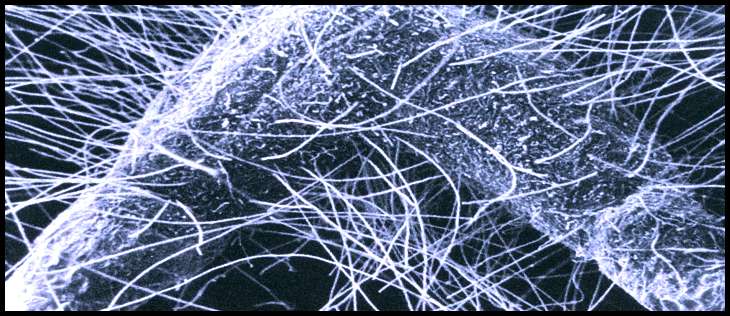
mycorhizae

Putting it all together!

Mycorrhizae forms an invaluable part of ecosystems around the world and can be found in some form or another in just about any ecosystem. In many places, whole forests and ecosystems wouldn’t exist at all without their mycorrhizal friends!!!

Tip: When you re-pot your Pine make sure to collect as many of the very recognisable white Mycorrhizae threads from the root ball and put that into the rootball and in the fresh new soil! This will help the making of a new healthy roots environment enormously!

In short: to all newbies, and Bonsai friends who read this article: Don’t take just one person’s word or video for the Bonsai truth! Because the number of video views doesn’t show if anyone is a knowledgeable Bonsai authority or not! But their Bonsai/work often dos! Look things up in books and online or watch videos from people that truly know what they are talking about! Join a Bonsai Club and talk, ask and learn there from the people with experience and Bonsai that clearly show that they understand Bonsai!

Cheers and stay safe,

Hans van Meer.

Note: for me to get it all just right and in proper understandable words I used parts of it from free-to-use sources! If I can find the right info, so can you! 😉
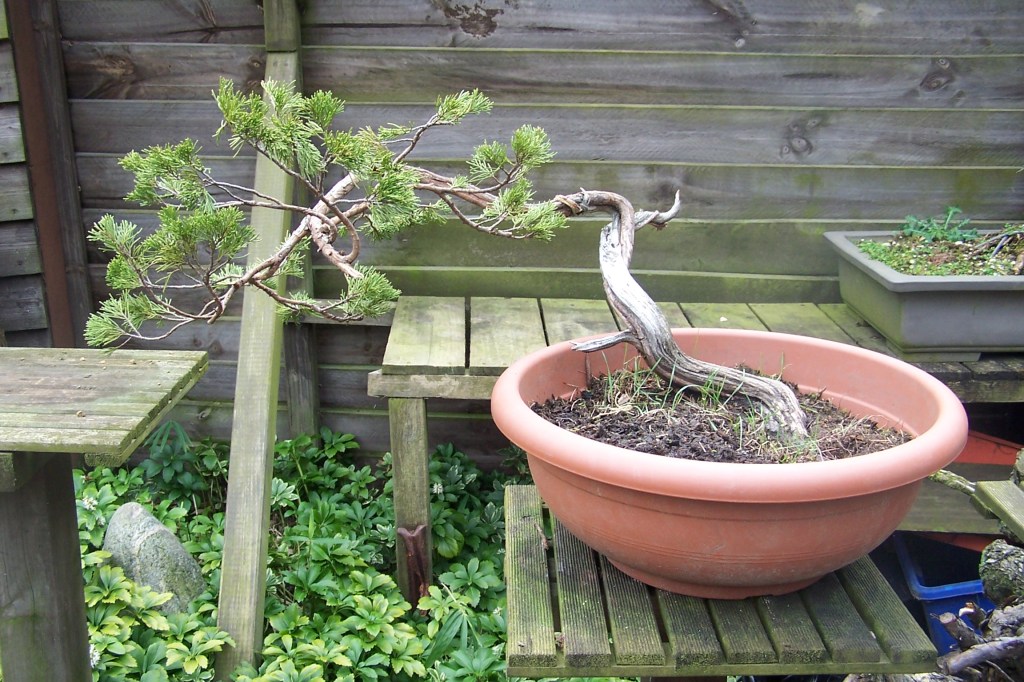
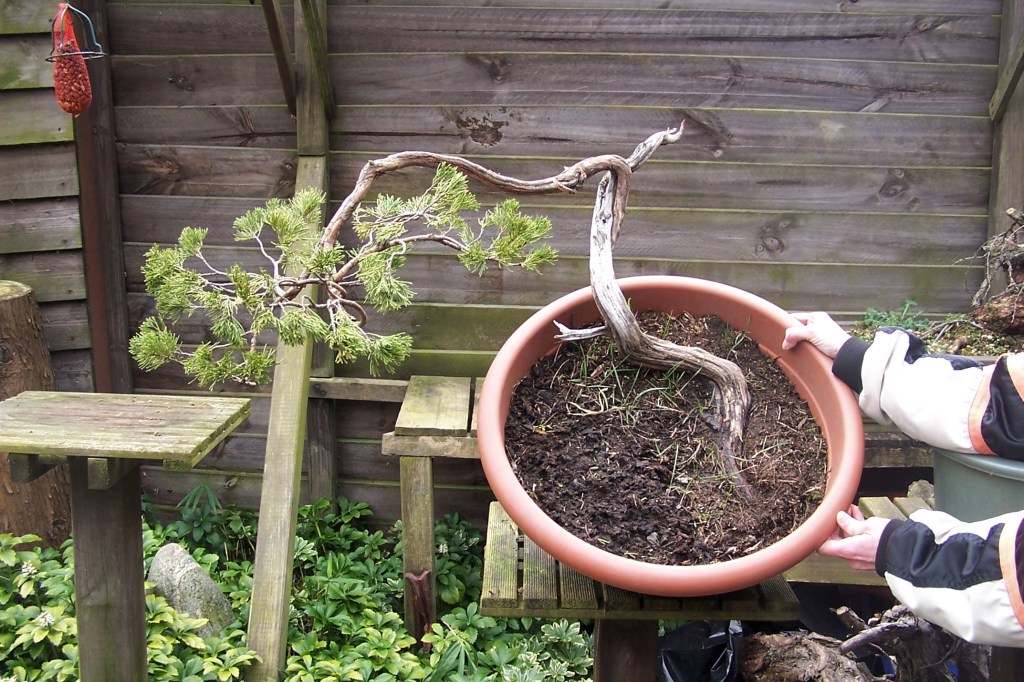
Old pictures of the first styling of a Juniperus Sabina Yamadori.

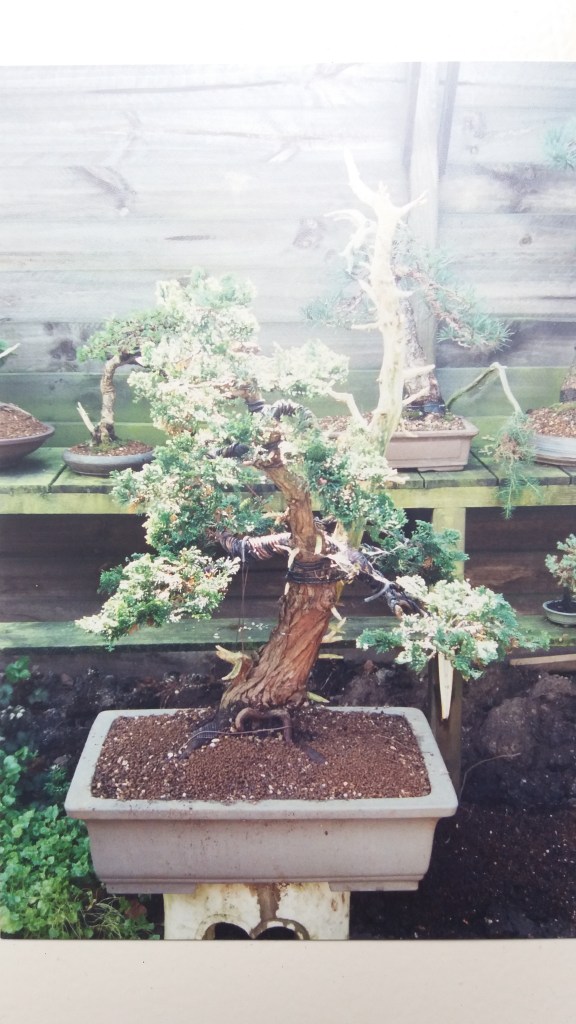
During my last week’s search through, thousands of photos I came across some forgotten foto I made of the first styling of a Yamadori Juniperus sabina I did way back in 2004. This tree was a gift from my old Bonsai friend and highly regarded college Serge Clement from Switzerland. He gave it to me right after that year’s Noelanders Trophy and it was if I remember it well used as a demo tree by one of the other demonstrators that year?!

Below: At home the next day I removed all the copper wire and then this Sabina is basically needly cleaned virgin material again! It now was pretty basic material with a nice Shari running along its trunk.

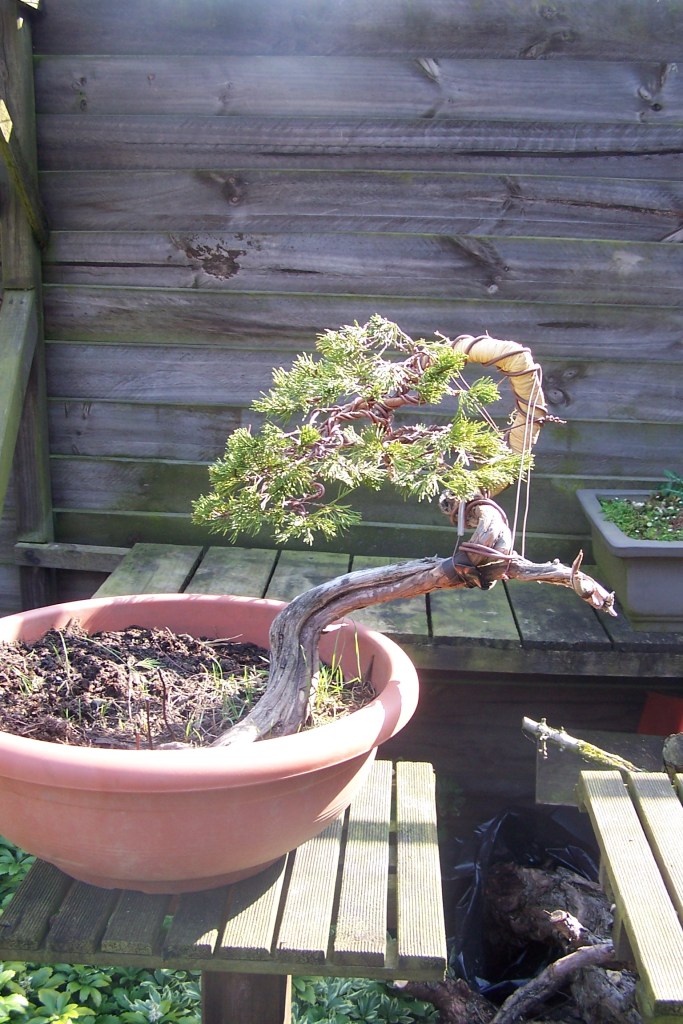
Below: The biggest problem that I faced was that the long base of the tree that was growing from the front of this container to the back of the container where it finally decided to grow upwards, but still away from us, and it would take some heavy bending to make it more compact and interesting! Basically, that top needs to be placed above that section where the trunk appears from the soil!

First, the whole top was tightly wrapped with a layer of water-soaked Raffia and then lengths of aluminium wire were placed lengthwise on the outside to make the heavy bend. Then the other layer of wet raffia was applied over it all and only then was I able to slowly and safely but with great force bring the whole top section into its new place!

Now fast-forward some 8 years to the year 2012 at the last edition of dear friend Tony Tickles famous/infamous Burrs Bonsai weekend experience where I was once again one of the lucky teachers. My friend Mickey from the UK who the year before became the new caretaker of this tree was also there and had brought along the Sabina of this story to further improve it. A college teacher had told the disappointed owner Mickey (below) that it would be difficult to bend the thick and old trunk that far. So really motivated we first tightly applied a layer of water-soaked Raffia and then a few lengthwise placed 4 mm copper wires on the outsides of the curve and then another layer of Raffia and then normal wiring on top of that. And then we together slowly bent the whole top section from the back side (see picture) to the front side of that trunk without any trouble. Micky had the time of his life! 😊 I wonder how they both are doing and I hope fine and healthy! 👍😊

Above: before bending with owner Micky. I am so excited!!!😬😁

Above: Success! The whole top is completely on this (front) side of the trunk now! But because of all the heavy bending, the fine wiring would be done later when the tree shows she is healthy and without any ill effects or weakness from what we have done! Patience is an important basic tool we all need in this hobby/art form! The deadwood was treated with Lime Sulfur to bleach it and protect it. 

Cheers and stay healthy,

Hans van Meer.

Wound treatment technique… sometimes it those work!!!

The main reason in my opinion why the large wound treatment that I now and then use is not so popular is that it has just a very small percentage of success and that is perfectly understandable! But remember that it is used in situations where otherwise large branches or roots would have been completely cut off leaving large wounds on our Bonsai, that in most cases never heal leaving ugly large scars…so what is there to lose?! And if those work…well then there is everything to gain! But judge for yourself!

This little Hawthorn was collected by me during a collecting trip in Wales way back in ’98 or ’99 with Tony Tickle and Terry Foster. During collecting this beauty, I had to cut through a massive root to be able to collect it!

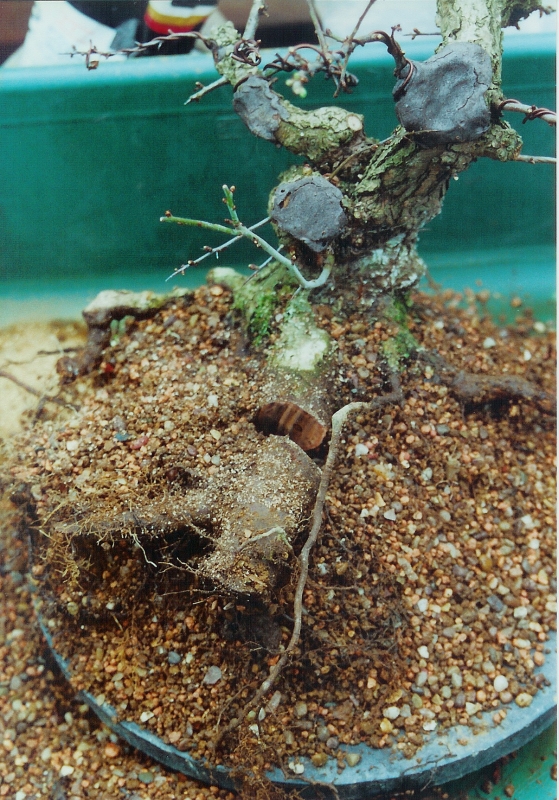
Below: Just a few years later during its first repotting, I saw that lots of tinny new roots were growing from everywhere including the sides of that thick and massive root so I decided to shorten it even further to stimulate new roots to grow even closer to the trunk!

And another few years later when enough healthy side roots were growing from closer to the trunkline that still massive root was shortened even more and with my Dremel I carved coming in from the cut side a wedge shape out off over the length of that root making sure not to wound the bark! And then I carefully folded the saved bark back over the V-shaped wood and secured them in place with some pines. Cracked bark on the newly created (now) two roots were protected with Cutpaste. I figured out that nothing was lost trying this and if it would not work…well then I could always cut it off and live with another large wound on such a small tree?!

Below: Skip over to November 2012 and this is how those now 2 roots look! The bark has already aged a lot and is growing in almost all places needly around the created root shape!

Below: And then skip forward some 8 years to see how those roots look today! Still alive and looking pretty convincing in my humble opinion! Only the right one has a tinny strip of deadwood on the inside..but that makes it only more convincing and in style with the image of this battered old Lil tree! And be honest, this looks so much better than another gaping big scare on such a little tree?! So when possible give it a try…you never know?! And you can always cut it off later!
Cheers and stay safe,
Hans van Meer.

The story of 3 rare old Dutch Hinoki Cypress urban Yamadori.

In the early 50 of the last century, growers in the little famous village “Boskoop” in Holland started to grow on a larch scale among others Chamaecyparis obtusa nana gracilis or Hinoki cypress. This species proved to be very hard to grow from cuttings so they started to graft them onto the much stronger and faster-growing Chamaecyparis lawsoniana. The survival rate was much higher and the plant has a higher survival rate. But because of that, the bottom root section/base of this new plant grew much faster than the top section and that is why we now still will almost always find older Chamaecyparis with overly large ugly bulging root bases! A second big problem with Chamaecyparis lawsoniana as a root base is that it is highly susceptible to the Phytophthora cinnamomi mould (root rot) and many invested fields needed to be destroyed because of this! But I am digressing! Anyhow…somewhere in the middle nighties I was visiting one of the literally hundreds of growers smack right in the middle of famous Boskoop. Where I started a conversation with the grower after he had been watching me for a while on my knees in the dirt looking under the bottom branches of a mighty original Chamaecyparis obtusa nana gracilis. He asked me why I was so interested in just this field full of old Hinoki’s? I explained enthusiastically just why I loved them and why I wanted to use them if I had one! And then he told me the story of how he as a jong boy in the 50ties had planted this, then much larger field, together with his father! And that since then over the last 40+ years literary thousand cuttings were taken from these so-called “Mother” plants and grafted onto stronger roots to be later shipped all over the world! I was over the moon that I was exclusively allowed to dig up 3 of these ungrafted and on their own original root base old beauties! And because all those constant cuttings were taken/cut off for so many years, all the foliage was growing still relatively close to the trunks and very usable for my future styling plans.

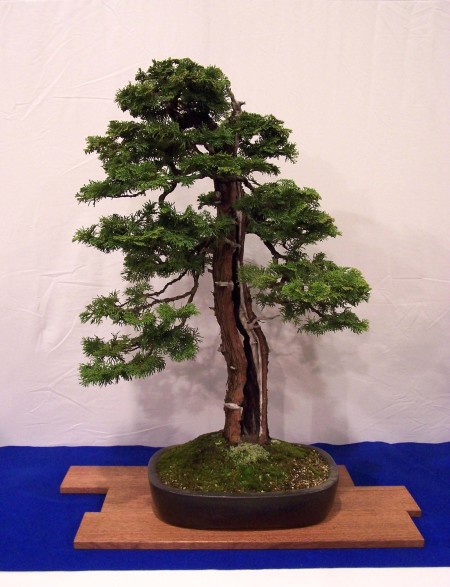
Below: And this is number one of those three Hinoki’s that I would collect that happy day! This one is about 110 cm high in this photo that was made when I proudly showed it in the 2009 prestigious Noelanders Trophy X. I sold it some two years ago to my student and dear friend Diederick who is now proudly the new caretaker and artist to take care of it.

The second one I collected that day in Boskoop, I later styled for the first time during my second demonstration ever at my then Bonsai club “KOYA” in Rijswijk (Holland). Later I entered the photos of this first styling into the national Bonsai styling competition to decide who would enter the Europian jong Bonsai talent competition that year. But I was excluded because they wrongly accused me of being a professional?! Many many years later it was sold to old student Ed van der Reek who brought this Hinoki to great heights and even won a nomination with it in the Noelanders Trophy!

Below: Oktober 2006 and still in my garden. It always was a special tree!

And this is the story of the third and biggest Hinoki that I collected that day.

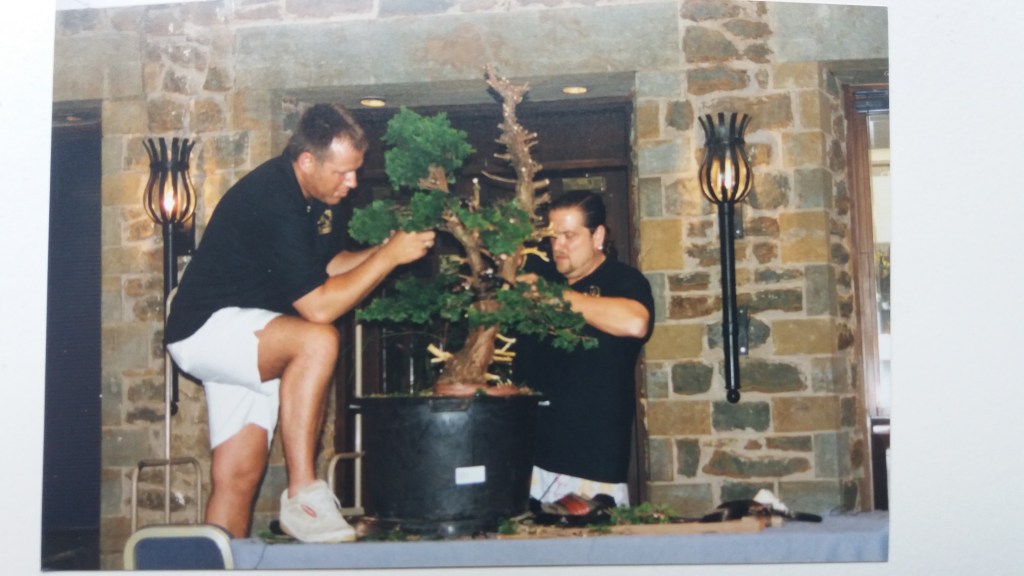
In 1998 I was invited to demonstrate at the 1999 E.B.A convention in Stratford Upon Avon and I immediately thought of my number 3 Chamaecyparis for my demo tree! It would be a big job to finish it in time, but I just had to try to style this so unique tree! Luckily my old friend Carlos van der Vaart helpt me (in amazing hot temperatures) to wire all those branches! My other old friend inventor of the “SAMURAI” carving tool William Vlaanderen was so kind as to bring this large tree with him on his bus. He had wrapped it tightly with plastic foil for the trip, but it had been so hot during his long trip that the poor tree had started evaporating enormously! So much so that all small branches had turned brittle and breakable! So extra care was necessary…but I made it in time!

Below: Carlos and I sweating away for many hours! 🥵😅

And because of this amazing tree, I had the privilege to meet two big names in the world of Bonsai: the very friendly Hinoki lovers Chase Rosade and his lovely late wife Solita from the USA! And they were really impressed with my Hinoki and the story behind it! Both are a bit of an expert in this field and had never seen anything like mine! And that made me even more proud of this tree and his legacy!😊

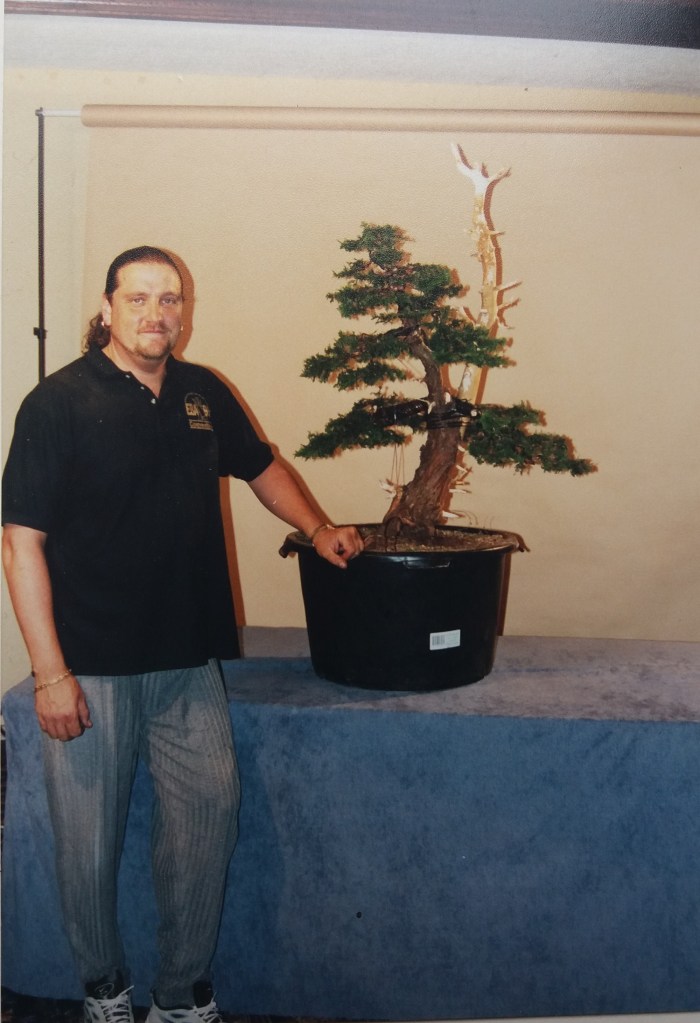
Below: And after a lot of hard work a warm but very proud me with the final result.

Note: the top of the foliage ends in this 1999 picture about 30 cm/12 inches under that Jin top! When I started to work on it again just a few weeks ago the top was 25 cm/10 inches cm above that same Jin! That is more or less 55cm/22 inches of growth in 20 years!!! And the trunk base has almost doubled in size without (of course) any swelling!

Back at home, it was planted with no problems in a large proper pot! This was as expected because the groundwater level in Boskoop is very high all year round and rootballs are ones every year cut to size with a spade and are because of that always compact and never thirsty! Since then it has been repotted only once into a new better brown-coloured pot and it is still very happy in that one today!

Below: Last year I shorted two thick branches that were growing at the top and just last month I cut off about half of all the too-long branches to open up the inner part of the smaller branches and foliage to re-direct sunlight so that they could gain in strength! Backbudding is always an issue with Hinoki’s and it is a constant struggle to not lose growing power on the inner parts of the tree! Light is a must and cutting back new growth with fine and sharp scissors (never pinch!!!) is a very important task! New growth on older branches is very rare so you don’t want to loos what you got!!!

Below: The amazing flakey trunk base with an old root Jin. Perimeter: 56cm / 22inch.

Below: Finally, the whole beautiful old trunk line can be seen again! And when it is recovered well from this whole operation then it will be wired again and repotted with new soil into this same pot again!

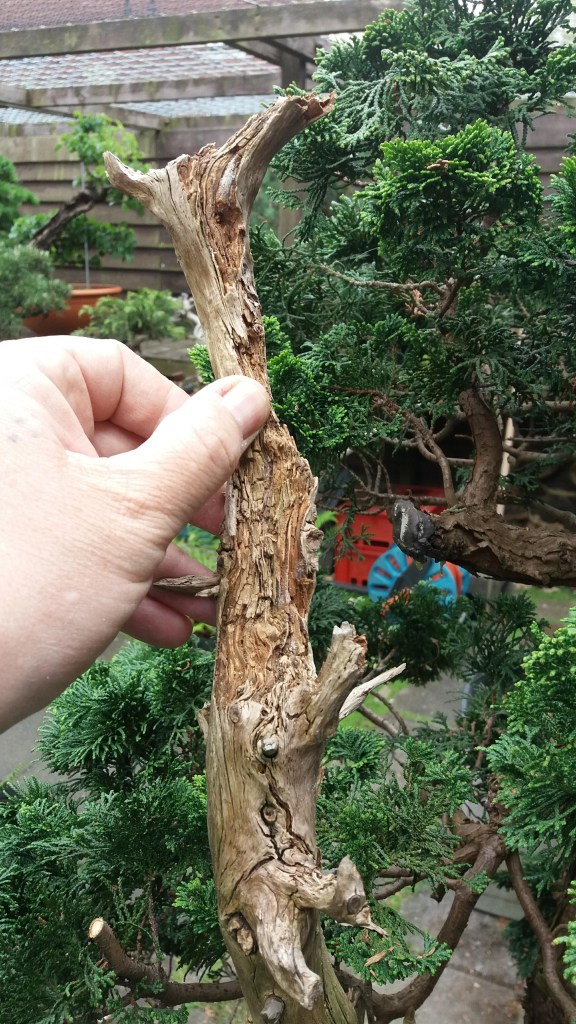
The backside of this tree was always facing the wall so always in the shadow side and that meant that this Jin was always longer wet on the backside for 2 decades-long and that means that the front sunny side is still as it was when it was just stript off its bark…but the backside was so rotten on the outside that I could shape it with my bare fingers and a steel brush. Peeling it away until the stunning natural-looking unrotten wood was revealed! Looks better than any power or hand tool could ever do! 😍 So from now on the front side of this Jin will be kept moist as much as possible to create the same stunning effect on the frontside deadwood as on the backside!

Below: All needly trimmed and opened up and now fingers crossed for lots of back budding and inner growth.

I hope you all enjoyed this short story about these 3 amazing old Dutch Urban Yamadori Hinoki?!
Cheers and stay safe,
Hans van Meer.

A completely new design and front for my old Mugo Pine named “Little chapel”.

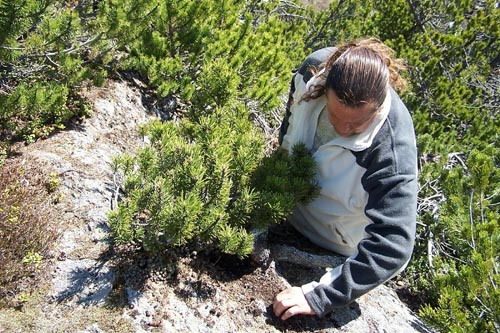
First a short history recap: Way back in 2004 I discovered and collected this little old Mugo Pine on a high mountainside in Austria. I only had to cut a few roots and then could literary scoop it off of the giant rock it had grown on for so long!

It was collected high in the mountains close to a little chapel and that’s where she/he got her/his name from Little Chapel!
Way back in 2006 in a training pot.

Below: 2007: With the progressive styling story of this same tree, which covers the complete progress right from my collecting it, right up to its first styling, I won the first AoB professional online styling competition back in 2007.

And I am proud to say that the winning article about this first styling was featured in famous Bonsai master Robert Steven’s Bonsai book “Mission of Transformation”!
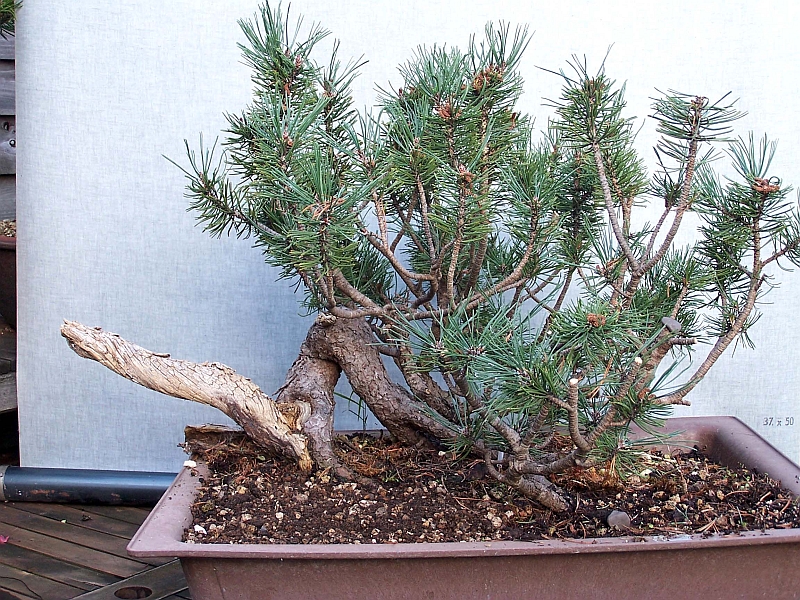
This is how it looks after its second restyling in 2010.

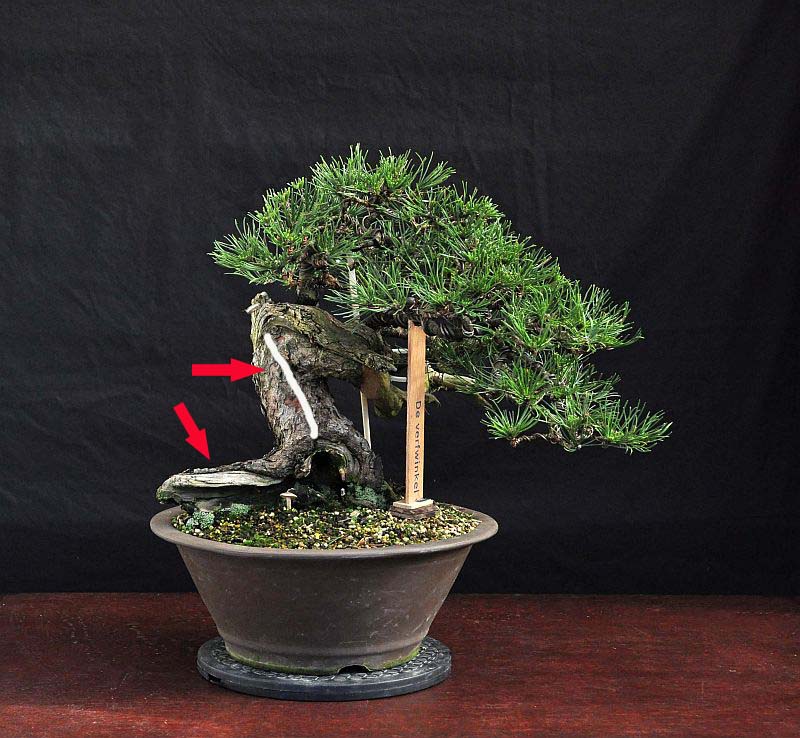
Above: And in Oktober 2012. First to clarify to those that wonder: On the backside of that to the left protruding deadwood, right at the left end there is a thick large rot growing straight into the ground! The bottom red arrow is pointing to the dying root that feeds the life vein that runs over the top of the left deadwood section. The top red arrow points to the dying left side of the trunk! Today in 2020 only the section to the right of the white line is still alive!

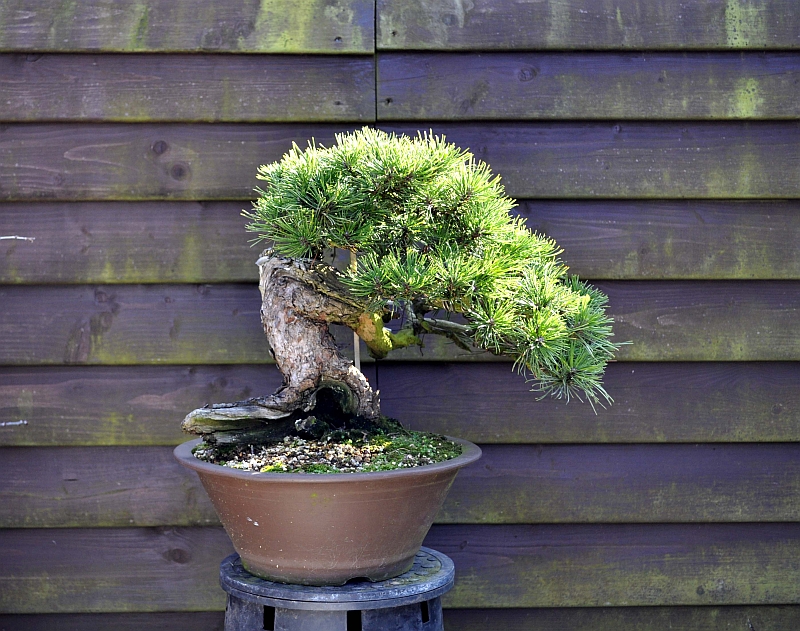
Above: 19-3-2015 Here the root visually still looked alright…but I knew that it was dying back slowly or already dead! So my initial front slowly lost its main attraction! Meanwhile, the tree was allowed to vigorously grow out of shape and to produce many new small branches and foliage pads for me to use! And the more I looked at it, the more I realist that a big change was needed for my new future plan!

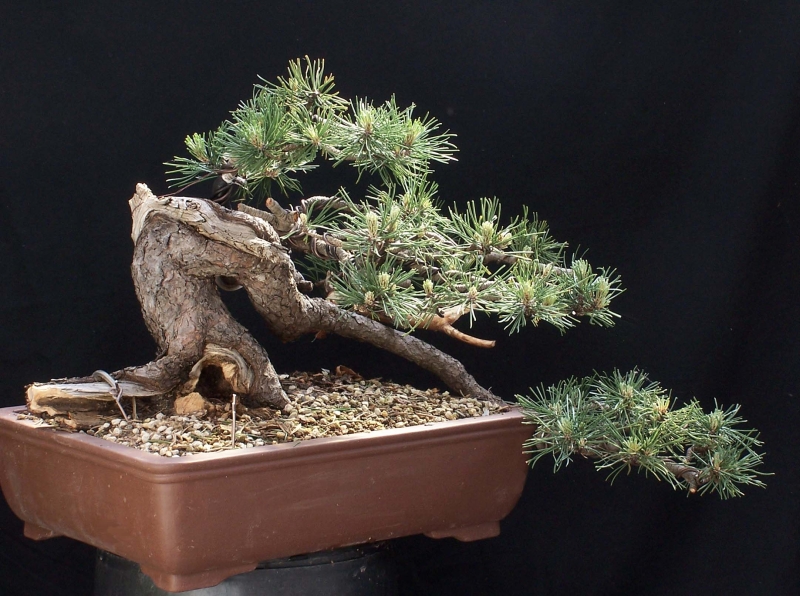
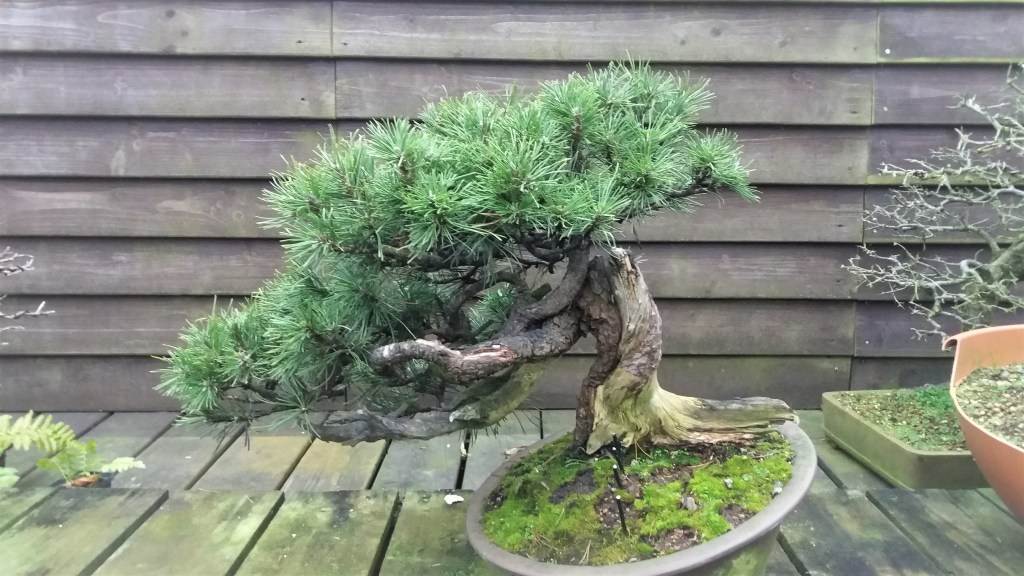
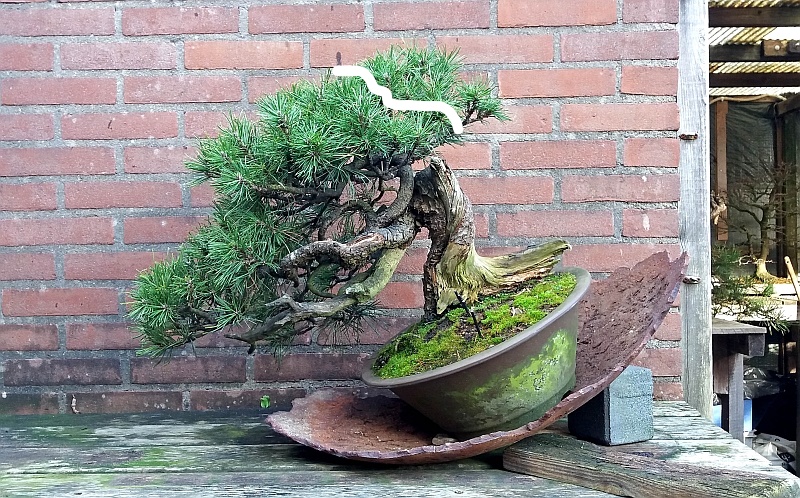
Above: And this will become the new front side! It will be planted sloping to the left like it is struggling to hold on to the mountainside it is growing on! This way the dead root/trunk enhances the story of its struggle. All (eye) movement in branches and foliage will be pointing to the left, creating a lot of visual speed and a feeling of a tree that is proudly holding on for dear life above a lot of open space. It will be styled in a natural-looking way enhancing the beauty of its years-long struggle! Hopefully more like a Lil’ Tree than an overly styled-looking Bonsai?!

Above: Branch to the right of that white line and a few back branches need to be removed! I really love how its cascading branches will be hanging above all that empty space beneath it in the future in a yet-to-be-found/made pot! PS: it has been in this pot for 13 years now…yes without repotting it once! We repot our evergreens way too much!

Cheers and stay safe and healthy,
Hans van Meer.

Preparing my little Prunus spinosa for the Deshima Bonsai Studio New years Bonsai exhibition.

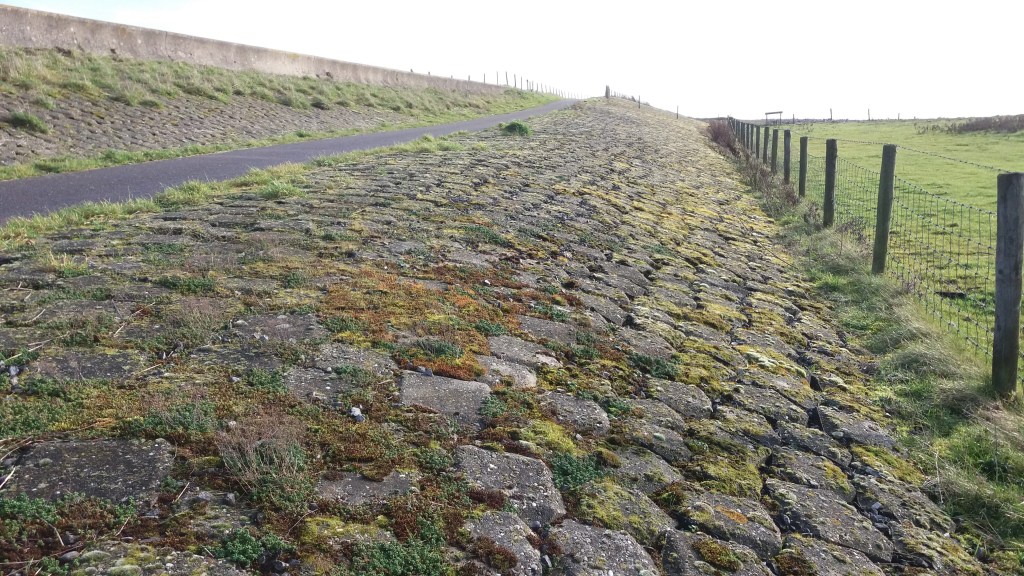
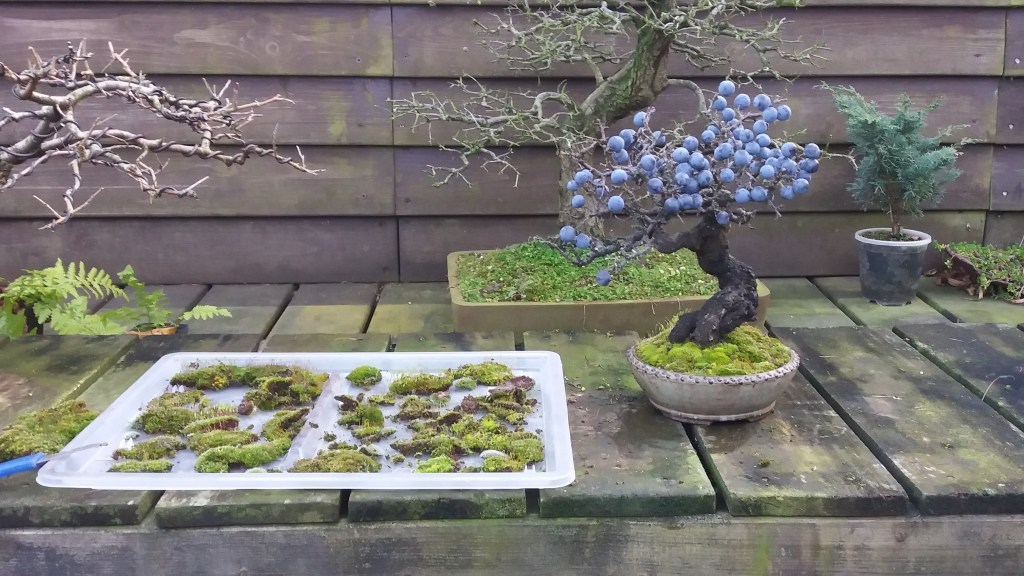
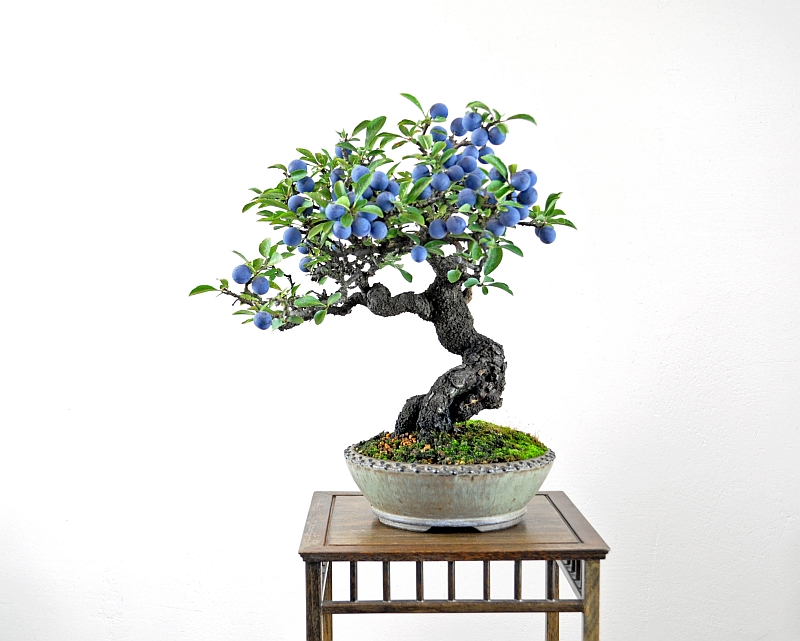
My Little Prunus spinosa will be shown together with my Hawthorn in one composition. It’s show ready and pretty unique because it is still covered with its summer bleu berries! Normally they would have been long eaten by birds, but my garden is covered with netting so they are still on there and the contrast between the bare black branches and bark and the grey American pot is simply amazing! The only thing that was still missing to complete the whole picture was nice moss on the soil surface and I know just the place to collect it! Just a 5 minutes walk away from our house there are meters-high and kilometres-long dykes to keep out the sea and on the rocks and boulders that make up this dyke, there are growing two perfect kinds of moss!

Miles and miles of endless dykes that protect the people that live in the lowlands meters below sea level called “The Netherlands” or like we say “Holland”!
Here grow just the perfect mos for Bonsai! It is not too thick/high and stays good for years and years!
Everything is ready to start the fun work of puzzling the pieces of moss together into a natural-looking carpet!
Make sure that the soil and moss are moist so that they will stick to the surface!
The moss with tinny stems with tinny seed pots on top is placed to the left and right behind the base of the Bonsai near the back of the pot. This creates a sense of depth, especially in pictures!

I am really happy with the outcome and how she looks! Now I still have to select a company plant and search among my several wooden handmade Tanzaku holders for the best one! And then go through my collection of Tanzaku (small paintings on paper or silk) for a nice wintery painting to complete the whole composition…but that is for tomorrow! I love this part of the Bonsai hobby! I will post some pictures right after the show so watch this space!

Happy New Year everybody!

Hans van Meer.

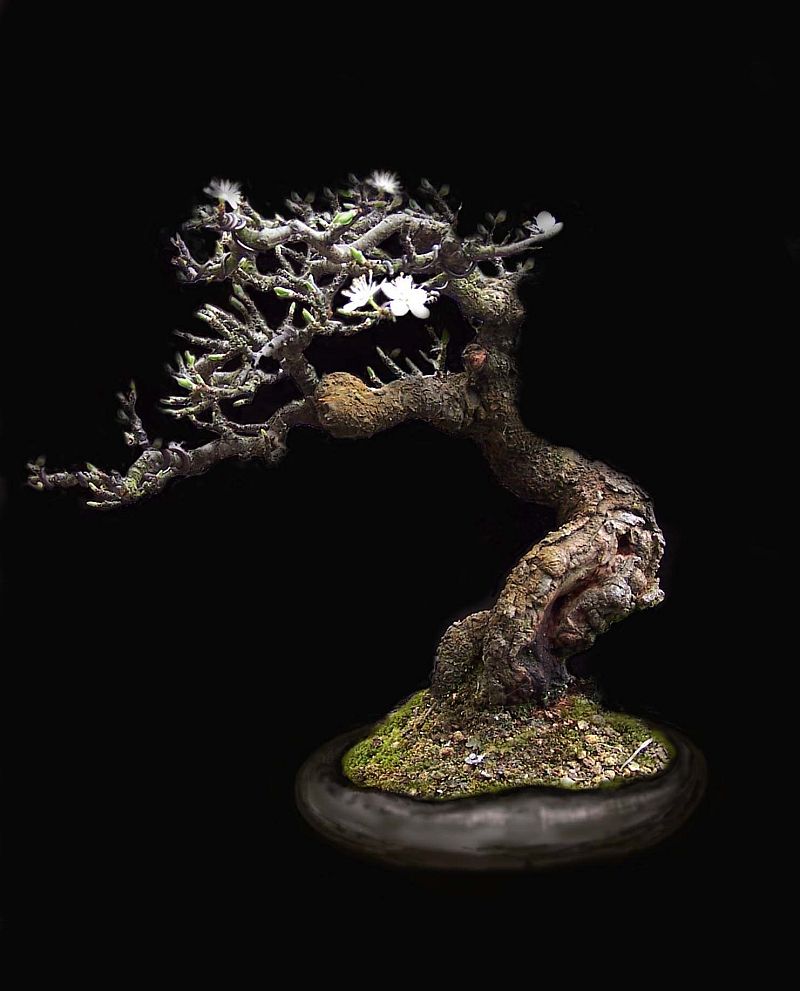
New pictures of my old Yamadori Blackthorn and a link to my 2 latest video’s on YouTube!!!

Hi everybody,
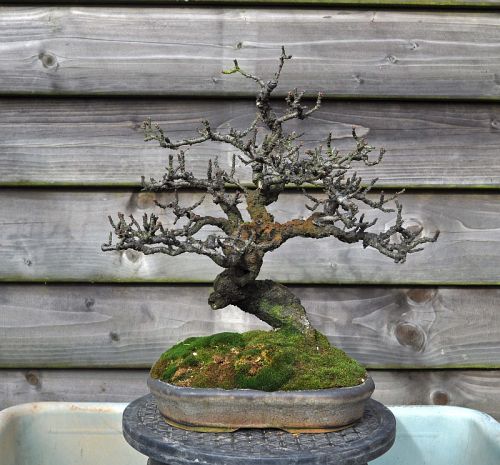
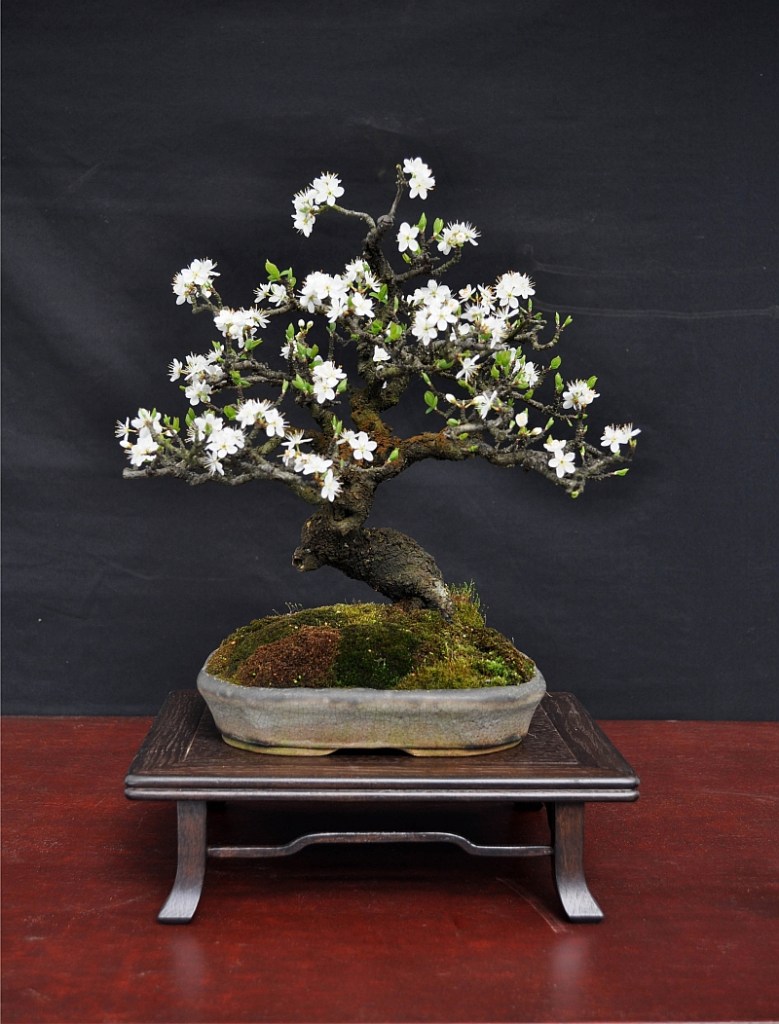
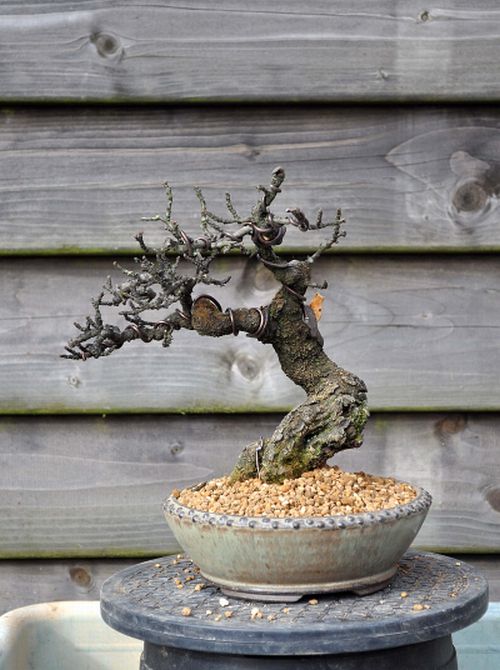
it must have been some 20 years ago that my dear old English friend Terry Foster gave me as a gift the even then-old Yamadori Blackthorn from this story. I cultivated and trained this small beauty for many years as a small 25 cm Moyogi but I was always disappointed that the natural Shari/deadwood was hidden on the back of the tree and that there was an obvious reverse taper at the base!

Here she is still styled as a Moyogi.
And with beautiful flowers.

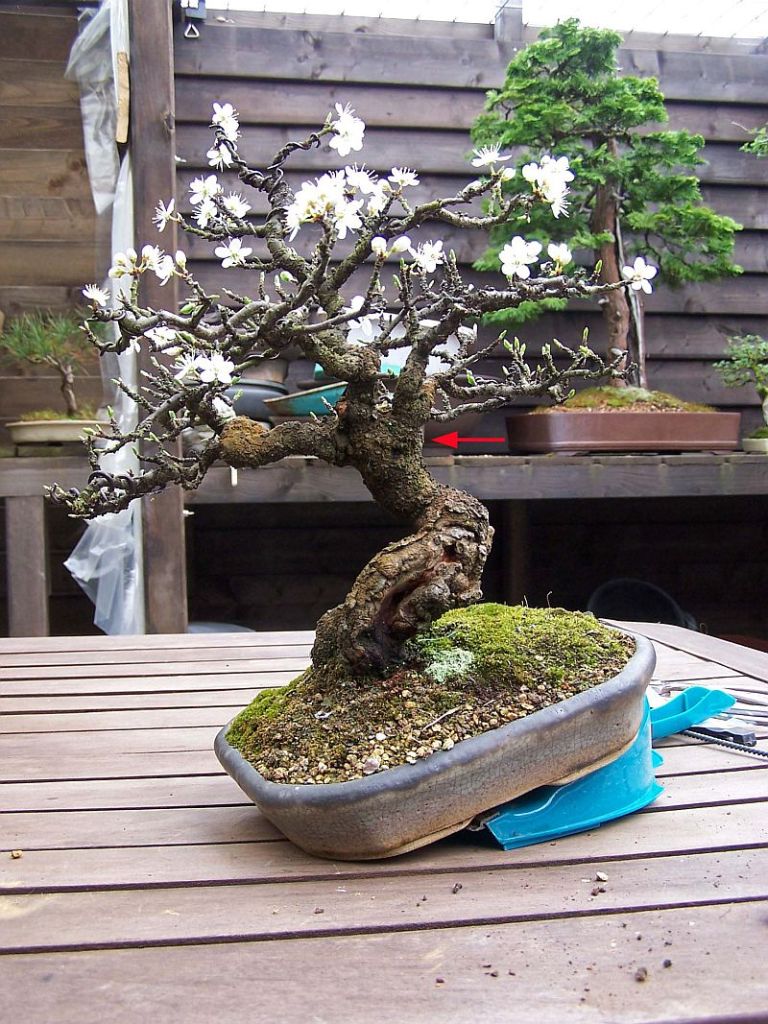
And then some 8 years ago I got a brave idea to turn her around! That meant that I had to cut off a major branch and rearrange most of the existing branches!

Above: This is the drawing that I made of my plan.
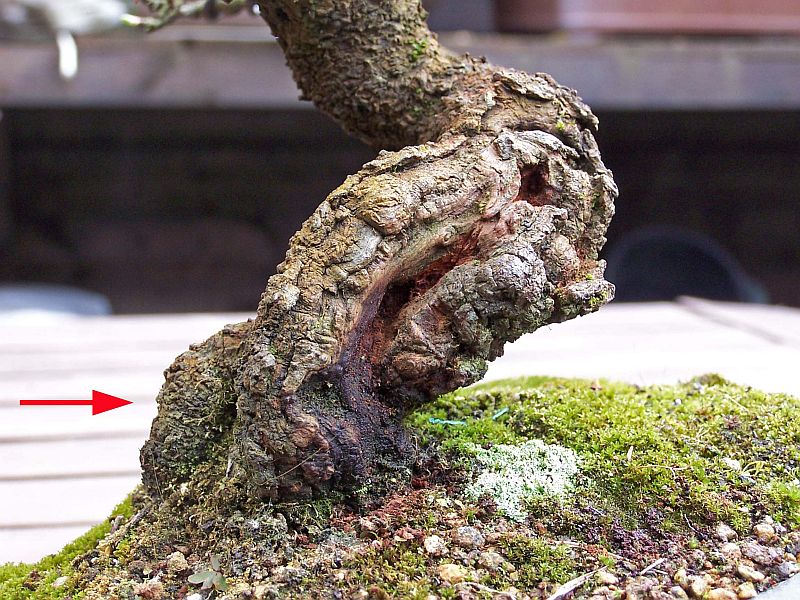
Above: Just look at that amazing natural Shari/deadwood!
Red arrow points at the twisted Nebari/roots.

Red arrow points at the branch that needs to be removed leaving a small Jin. This will create together with the new planting angle movement to the left and an image of a wind-battered tree!

Above: Cutting that beautiful but unwanted branch!
Sometimes you have to be brave!
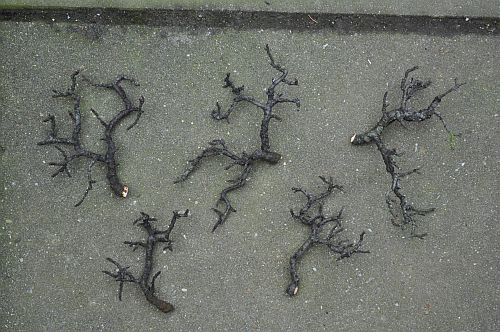
Above: Red arrow: this thick root will be cut right back to the Yellow arrow!
Above: May 2012 in its new American? pot!
Above: Oktober 2019. And this is how she looks today! Covered with berries and looking just how I had hoped for! I hope you like her as much as we do?!

I promise to post some more soon so watch this space! In the meanwhile, you can watch my two latest videos on YouTube!

Cheers,

Hans van Meer.


Cheers,
Hans van Meer.

REPOTTING MY ULMUS PARVIFOLIA WITH GREAT 27 YEARS IN THE MAKING ROOTS (NEBARI).

Hi everybody,

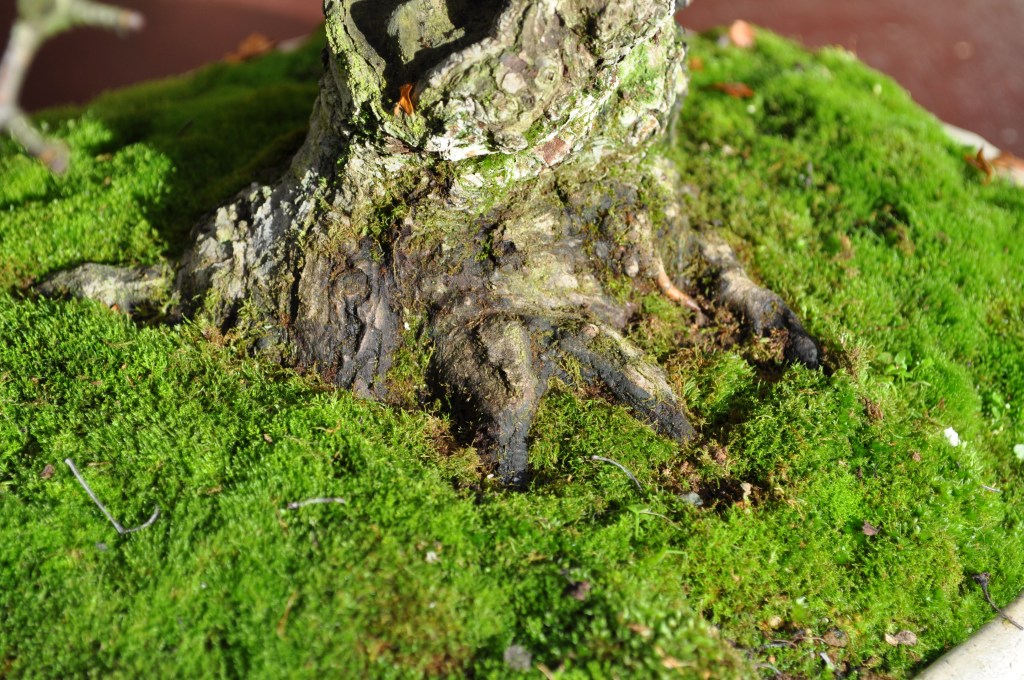
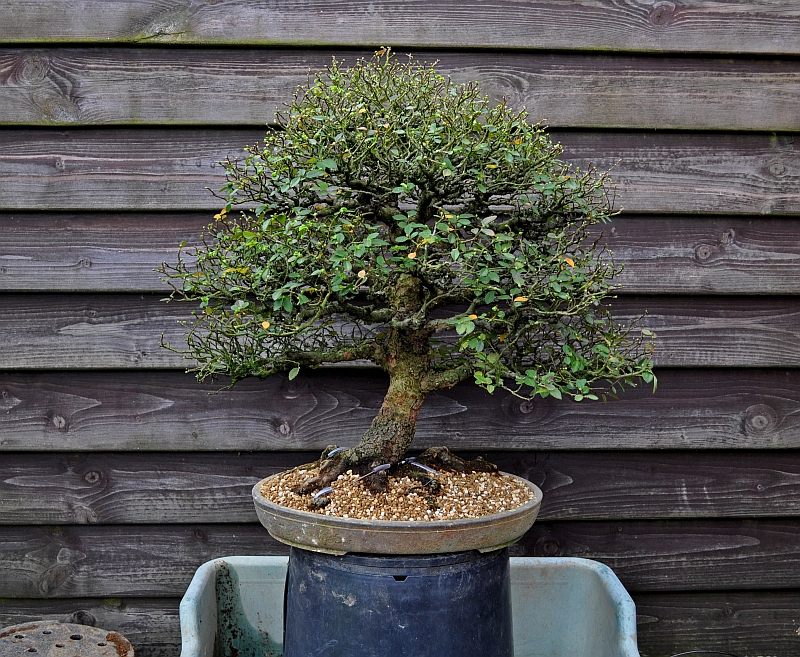
here are some pictures I made a few weeks ago when I repotted my old Chinese Ulmus parvifolia that I have been training and styling for some 27 years now. Most of that time was spent on first building a solid and old-looking basic branch structure and that meant letting grow a lot to thicken and then cut. That took at least a full decade to accomplish and then it was more work combined with creating the secondary branch and later even tertiary branch structure! Letting grow and cutting back and sometimes cutting back hard or complete or partly defoliation everything was done during all those years to create a natural and old-looking branch structure that was best seen during the dormancy winter time! And of course, during all those years I worked on the roots and base of the tree! It started with not many roots at all and what was there was too fat or tiny and grew from the back side of the tree! So after a few years of growing as soon as there were new but tinny roots showing I started to wire them carefully into the desired position and from there kept on guiding and coaching them for all those years until I was left with great old-looking roots and a firm root base! Years of cutting back every root that grew downwards made it possible to stay in the same shallow pot that it grew in for the better part of its Bonsai life in my garden and that is great because I really think that this pot suits this Bonsai in colour, shape and size! This species is really a bit looked down upon because they are still associated with indoor and Mall Bonsai (mallsai) and that is a shame in my opinion because they can be shaped relatively easily into very believable Bonsai! They have amazing flaky bark and grow stunning root bases and branch structures! They are winter and summer hardy up to a point and tolerate hard pruning or defoliation without any problem. They are not easily receptive to insects or fungi and grow in almost anything! This little Bonsai was some 10 years ago even proudly shown in the prestigious “Noelanders Trophy”…so it can be done! So my advice: if you can find a nice promising one..give it a try! And I promise you that you will be surprised just how suited they are to live as a Bonsai and just how pretty they can become over time!!!

Below: close-up of the Ulmus back side Nebari.

Below: Backside.

Below: close-up of the front side Nebari.

Hope you enjoyed this little Ulmus story?!

Cheers,

Hans van Meer.

Info: karamottobonsai@hotmail.com

——————————————————————————————————

DEADWOOD AND WIRING WORK ON MY OLD YAMADORI PRUNUS MAHALEB FROM SLOVENIA.

Hi, everybody,

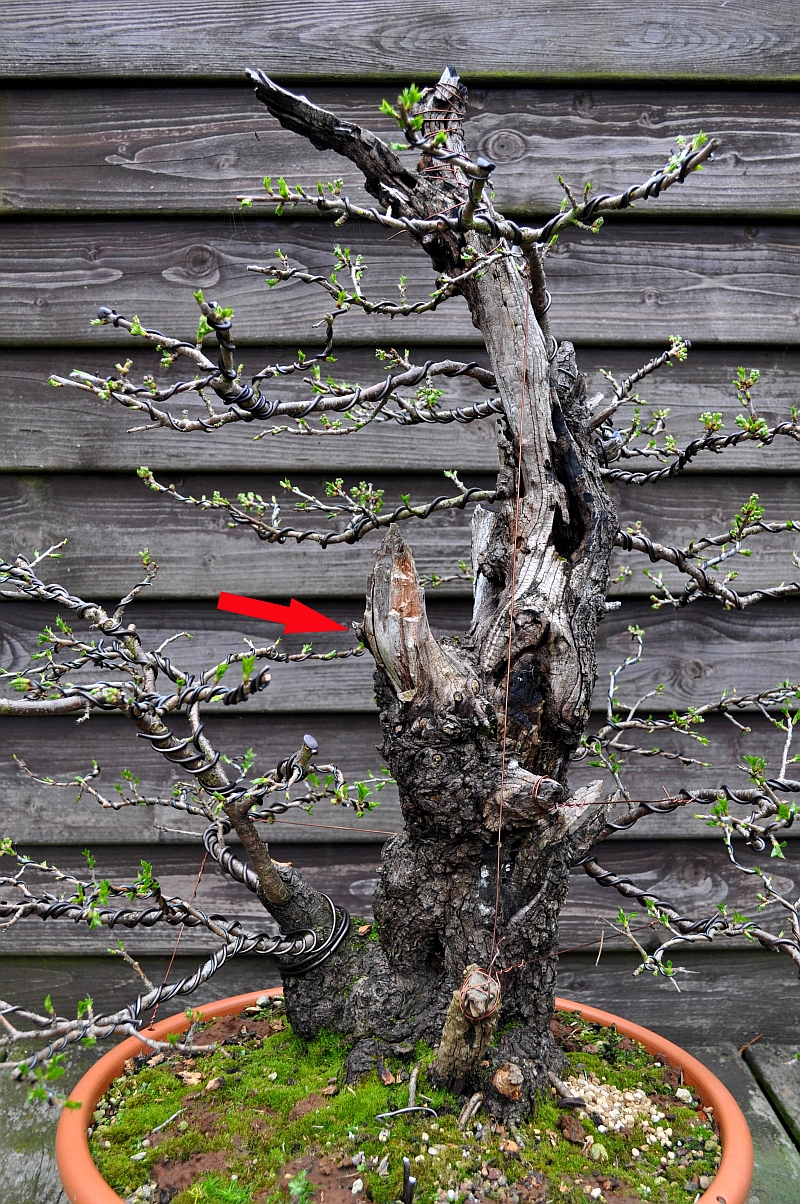
two weeks ago we had some record-breaking warm weather so it was a great opportunity to do some wiring and deadwood work on one of my favourite Prunus Mahaleb Yamadori’s from Slovenia. This pre-Bonsai is full of naturally burned and sun-bleached deadwood and I want to recreate that in the Jin and Shari where I am going to work. Almost all of the branches of this tree are newly grown by me and need more fine branching and ageing, but I am not in a hurry! I was a bit laid with wiring it almost completely and had to take great care not to break off any of the new growth that was emerging fast because of the sudden warm weather of the last few days! We went from frost in the night to almost 30 degrees during the daytime in one week’s time…really crazy weather!!! After I finished the wiring and styling it, for now, I started to work on the front Jin and Shari with a power tool. The main focus was on reducing the Jin and Shari because there is a reverse taper and bulging section on it that needs to be reduced and shaped as naturally as possible so that it will fit in with the rest of all the natural deadwood on the tree!

Below: The Prunus Mahaleb after I just finished the wiring. Height 67 cm. I kept it as natural looking as possible and preserved the second small trunk on the left bottom side of my design! I allowed it to grow freely to create a for now still young-looking small secondary tree to accompany the larger tree on the right! I guess you could call it a Mother and child design?!

Below; the red arrow points at the deadwood part that is thicker than the section below it. The Jin is too thick and the section below it is somewhat bulging and forms a reverse taper!

Below: Taking my time and enjoying it while I am taking away excess wood and shaping at the same time. I love this fast creating-a-result part of doing Bonsai!

Below: The result is that the Jin is less bulky now and looks like the remains of a large branch/trunk that has been torn off by a storm that created a long wound that runs down through the bark below it. In that way, the reverse taper or bulge is less obvious! Now the fresh deadwood needs to be scorched with a small burner to mimic the crackly image of the originally burned deadwood on this tree.

Below: after carefully burning the fresh deadwood it looks just like the original deadwood of this tree. I will not brush it to preserve the cracks that look just like the ones on the natural deadwood on the right side of it! There is a forecast of rain for the next couple of days so I will bleach it with diluted Lime sulfur to mimic the original lightly bleached deadwood! I will post pictures of it later.

Hope you enjoyed this little story?!

Cheers,

Hans van Meer.

Info: karamottobonsai@hotmail.com

——————————————————————————————-

Link to: Decandling black pine Bonsai. An in-depth guide by JONAS DUPUICH.

Hi everybody,

I just finished reading a great article on the BONSAI TONIGHT FORUM by Jonas Dupuich about “DECANDLING BLACK PINE BONSAI” and it is so well written, easy to understand and all you need to know that I would like to share it with you all! Here is the link and thanks to Jonas Dupuich for writing this very helpful article!!!

Cheers,

Hans van Meer.

Info: karamottobonsai@hotmail.com

———————————————————————————————